
Black bulgar
Bulgaria inquinans
Description
Symptoms
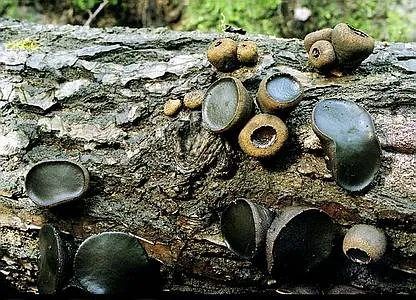
An external sign of the fungus is the appearance of dense, gelatinous, disc-shaped or cup-shaped fruiting bodies on the bark of infected trees.
These fruiting bodies are typically black with a shiny surface and are often found in small clusters, making them clearly visible on the trunks.
During maturation, the fungus releases a large quantity of black spores that stain hands or bark upon contact, which inspired the common name.
Infected wood gradually loses structural strength, showing signs of surface degradation, which is often accompanied by bark cracking.
In the later stages of fungal development, localized areas of tissue necrosis can be observed, leading to the overall weakening of the tree.
Pathogen
The causative agent is the fungus Bulgaria inquinans, which belongs to the division Ascomycota, order Helotiales.
It is a saprotrophic, and often weakly parasitic fungus, specializing in the decomposition of hardwood species.
The primary host is the oak tree, though the fungus can occasionally be found on hornbeam, beech, and other broadleaf trees.
Biologically, the fungus can develop on both dead branches and weakened living specimens, entering through cracks in the bark.
The pathogen's life cycle includes an active sporulation phase, during which the fungus is spread by air currents to neighboring trees.
Conditions for development
Fungal growth is favored by high air humidity and frequent rainfall during the spring and autumn seasons.
Optimal conditions for spore germination occur in dense forest stands where airflow is restricted and moisture tends to stagnate.
Mechanical damage to the bark, sunscald, or frost cracks significantly facilitates the infection of the wood by fungal spores.
The fungus prefers shaded parts of the trunk where moisture remains on the bark longer, providing an ideal environment for fruit body formation.
Weakened trees suffering from nutrient deficiencies or drought stress are the most susceptible to colonization by this fungus.
Why it matters
The primary damage lies in the accelerated decomposition of wood, which reduces timber value and compromises the structural integrity of the trunk.
In parks or orchards, the infection leads to a loss of ornamental value and premature dieback of individual branches.
The gradual spread of mycelium inside the trunk disrupts sap flow, eventually causing the tree canopy to wither.
During mass development, the fungus can predispose trees to infestation by secondary pests, such as wood-boring insects.
The risk of tree failure increases as the fungus undermines the structural stability of the main trunk components.
Protection
The most important preventative method is the timely sanitary removal and disposal of dead or decaying trees from the stand.
Regular cleaning of trunks to remove dead bark is recommended to prevent creating favorable conditions for fungal spore establishment.
When pruning trees, all cuts must be treated with fungicidal pastes or wound dressings to prevent the entry of infection.
Maintaining optimal water and nutrient management helps enhance the tree's natural immunity against fungal diseases.
If single fruiting bodies are discovered, they should be carefully removed and destroyed to reduce the overall inoculum load in the garden.
Discussion
No discussions yet — be the first.