

Description
Symptoms
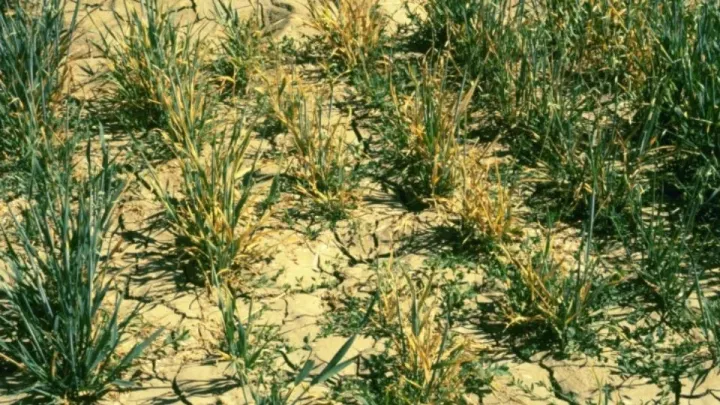
Symptoms typically include a characteristic yellowing or reddening of leaf tips, which gradually progresses towards the base of the leaf blade.
Stunting is a hallmark of the infection, with significantly shortened internodes. Affected plants often exhibit a bushy appearance due to reduced apical dominance.
In wheat and barley, leaves may stand upright and display vibrant yellow, gold, or reddish-purple (anthocyanin) discoloration depending on the crop variety.
Root system development is severely hampered, rendering the infected crops less capable of water and nutrient uptake, which exacerbates the stress on the plant.
In field conditions, the disease is usually observed in patches, reflecting the initial colonization patterns of aphid colonies on the crop canopy.
Pathogen
Barley yellow dwarf is caused by the Barley yellow dwarf virus (BYDV), which is an obligate parasite. It affects a wide range of monocotyledonous plants, including winter barley, wheat, rye, and corn.
The virus is restricted to the phloem tissue of the host plant. It is not transmitted mechanically or through seeds, meaning that insects are the primary mediators of the spread.
Various species of cereal aphids act as the exclusive vectors. The virus is acquired when the aphid feeds on the phloem sap of an infected plant for a specific duration.
Once acquired, the virus persists in the aphid for the rest of its life, allowing the vector to transmit the pathogen to multiple healthy plants over time.
Different strains of the virus exhibit specific preferences for different aphid species, which influences the distribution and severity of the disease across different regions.
Conditions for development
The development of the disease is strictly linked to aphid population dynamics. A warm, extended autumn provides ideal conditions for early infestation of winter crops.
Early planting often exposes young seedlings to migrating winged aphids, significantly increasing the risk of early-season infection and subsequent yield loss.
The presence of grassy weeds in and around fields serves as a reservoir for the virus, allowing it to survive and bridge the gap between harvest and the next planting season.
Optimal temperatures for aphid reproduction range from +15°C to +20°C. Within this range, the life cycle of the vector speeds up, leading to faster virus transmission.
Mild winters facilitate the survival of aphids on winter crops, enabling them to maintain virus reservoirs through the coldest months and spread infection early in spring.
Why it matters
The primary damage from Barley yellow dwarf is a significant reduction in grain yield. Infected plants produce smaller heads with shriveled and underdeveloped kernels.
Yield losses can range from 20% to 80%, depending on the crop growth stage at the time of infection. Early infection typically results in more severe damage.
The virus disrupts the translocation of photoassimilates to the grain, leading to a decrease in seed weight and overall grain quality, including reduced protein content.
Infected crops are also more susceptible to secondary environmental stresses, such as drought or frost, and are often more prone to secondary fungal infections.
Economic impacts include not only direct yield loss but also the additional costs associated with insecticide applications and lost input investments for the affected area.
Protection
Adjusting planting dates is a fundamental management strategy. Delaying the sowing of winter cereals can help avoid the peak migration period of aphid vectors.
Strict control of grassy weeds and volunteer plants in and around fields is essential to eliminate local virus reservoirs that harbor both the virus and the vectors.
The use of insecticide-treated seeds, particularly with neonicotinoids, provides systemic protection during the critical early stages of seedling establishment.
Monitoring aphid populations using yellow sticky traps allows for timely decision-making regarding foliar insecticide applications before the infection spreads.
Utilizing resistant or tolerant crop varieties remains the most effective and sustainable long-term solution for managing the impact of Barley yellow dwarf in commercial farming.
In brief
4
Affects crops
Biology
Pathogens and affected parts
Pathogens
Affected plant parts
whole plant
Content graph
Affects crops · 4
Content graph
Connections · Barley yellow dwarf
Most often together:
Marketplace
Products · 5


DOBRYNIA
Federal Agrarian Scientific Center of the South-East
Wheat
0
0
·
32
1 offer
0.81 €per pack
Buy


Community
Discussion
No discussions yet — be the first.