
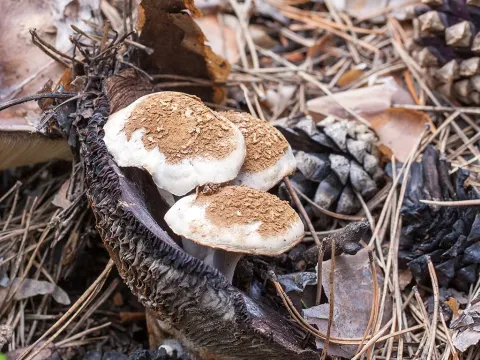
Asterophora lycoperdoides
Asterophora lycoperdoides
Asterophora lycoperdoides is a mycophilic fungus belonging to the order Agaricales. It is a specialized parasite that exclusively colonizes the fruiting bodies of other mushrooms, particularly species within the Russulaceae family.
What the section contains
Asterophora lycoperdoides
Unlike common plant pathogens, this fungus does not affect crops. Its primary biological function is the decomposition of existing fungal tissue, effectively acting as a parasite that eventually kills the host mushroom.
The fungus propagates through the production of numerous chlamydospores on the surface of the host's cap. These spores are highly resistant to adverse environmental conditions, ensuring the species' survival.
The lifecycle of this fungus is strictly dependent on the host's presence. As the host mushroom ages, Asterophora lycoperdoides mycelium penetrates deeper into the tissue to secure nutrients.
It plays a significant, though niche, role in forest ecology by recycling organic matter from other fungi, contributing to the breakdown of fungal biomass in moist forest habitats.
The most distinctive sign of infection is the appearance of a thick, powdery coating on the cap of the host mushroom. Initially, this coating is bright white, but it gradually turns brown.
The host mushroom exhibits significant morphological changes. The cap becomes deformed, soft, and eventually loses its structural integrity due to internal decay caused by the parasite.
Underneath the cap, the gills become completely obscured by the fungal growth. The entire structure starts to resemble a puffball, which is the most prominent feature of the infection.
The rapid transformation of the mushroom's tissue into a mass of spores is a key identifier. This process makes the original host almost unrecognizable within a short period.
In humid conditions, the mycelium forms a thick mat over the surface of the mushroom. The resulting dark, dusty spore mass is easily distinguishable from the normal tissue of the host.
High relative humidity is the most critical environmental factor for the development of Asterophora lycoperdoides. It thrives in damp, cool conditions typically found in forest environments.
Optimal temperatures for mycelial growth and spore production range between 15°C and 20°C. Cold weather significantly slows down the progression of the infection.
The availability of suitable hosts, such as old or decaying Russula or Lactarius species, is essential. Without a weakened host, the parasite cannot complete its lifecycle.
Spore dispersal is primarily mediated by air currents. Once the chlamydospores mature, they are easily dislodged and carried to nearby healthy mushrooms, initiating new cycles of infection.
Forest litter and shade are ideal for the parasite, as these areas maintain the necessary moisture levels on the surface of mushroom caps for an extended duration.