
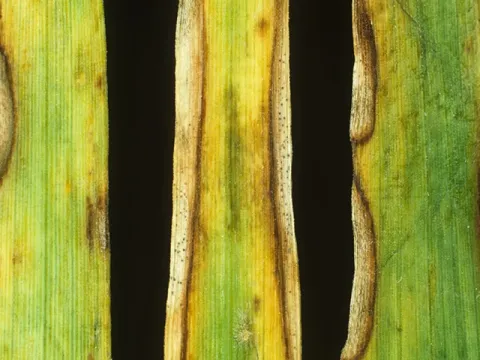
Barley ascochyta leaf spot
Ascochyta hordei
The causal agent of this disease is the fungus Ascochyta hordei, a member of the Coelomycetes class. This pathogen survives in crop debris, soil, and on infected seeds through its pycnidia.
What the section contains
Barley ascochyta leaf spot
The lifecycle involves the production of conidia within pycnidia. During periods of high humidity and rainfall, these spores are released and spread via wind and splashing water to healthy barley plants.
While the pathogen primarily infects the leaf blades, severe infestations can extend to the leaf sheaths and even the stem, leading to compromised structural integrity and metabolic function.
The fungus is highly resilient and can overwinter in plant residues. As temperatures rise in the spring, the surviving pycnidia resume spore production, initiating new infection cycles.
The mycelium penetrates the leaf tissue, colonizing the mesophyll and causing localized cell death, which manifests as the characteristic lesions observed on the foliage.
Early symptoms appear as small, light-colored spots on the leaves. As the infection progresses, these spots expand, often becoming oval-shaped with dark brown borders.
A diagnostic feature of Ascochyta hordei is the presence of tiny, black, dot-like structures known as pycnidia within the center of the lesions, which are clearly visible to the naked eye.
The infection typically starts on the lower leaves and moves upward. Under favorable conditions, the spots can coalesce, leading to extensive yellowing and premature drying of the leaf tissue.
Unlike some other fungal leaf spots, the necrotic area in ascochyta usually remains distinct, and the presence of abundant pycnidia helps distinguish it from other blight pathogens.
- Development of light-colored necrotic spots with brown margins.
- Presence of black fruiting bodies (pycnidia) inside the lesions.
- Yellowing and premature senescence of infected leaves.
- Reduced photosynthetic surface area.
Warm and humid weather conditions are the primary drivers of ascochyta leaf spot development. Frequent rain showers and high relative humidity facilitate rapid spore germination.
The optimal temperature range for the pathogen's growth and infection is between 18 and 25 degrees Celsius. These conditions significantly shorten the incubation period of the fungus.
Dense crop stands create a microclimate with restricted airflow, which keeps the leaf canopy moist for longer periods, thereby increasing the risk of widespread infection.
Over-application of nitrogen fertilizers can exacerbate the disease by promoting excessive succulent foliage, which is more easily penetrated by the fungal hyphae.
Monocropping or tight crop rotations involving barley increase the inoculum load in the field, making it difficult to control the disease once it establishes itself.
The primary impact of ascochyta leaf spot is the reduction of the green leaf area, which severely limits the plant's photosynthetic capacity during the critical grain-filling stage.
Premature leaf death prevents the translocation of nutrients to the grain, resulting in shriveled kernels, lower test weight, and reduced overall crop yields.
The disease also compromises grain quality, which can adversely affect the germination rate and vigor of seeds saved for future plantings.
Significant economic losses can occur during years with prolonged wet weather, especially if the upper canopy and flag leaves are heavily damaged by the pathogen.
In addition to yield loss, weakened plants are more susceptible to secondary infections and environmental stresses, further complicating the plant's ability to reach its yield potential.
Effective management begins with robust crop rotation, ensuring that barley is not planted in the same field for several years to allow existing inoculum to decompose.
Tilling and incorporating crop residues deeply into the soil is an essential practice to reduce the amount of primary inoculum available for the next season.
Utilizing disease-resistant barley varieties is the most sustainable strategy for long-term control, as it reduces the reliance on chemical inputs.
Seed treatments with systemic fungicides are highly recommended to protect seedlings from early-season infections and ensure a healthy start to the crop.
Foliar application of registered systemic fungicides should be applied when weather conditions are conducive to disease and the first signs of symptoms appear in the field.