
Barley stripe
Pyrenophora graminea
The causal agent of this disease is the ascomycete fungus Pyrenophora graminea, which has a conidial stage known as Drechslera graminea. This pathogen is a specialized parasite that exclusively infects barley crops.
What the section contains
Barley stripe
The fungus survives as mycelium within the seed (inside the hull and the seed coat) and as conidia on crop residues left in the field. Seed transmission is the primary method of disease spread.
The life cycle of the fungus is closely linked to the development of the host plant. Spore germination occurs simultaneously with seed germination, and the mycelium penetrates the seedling, colonizing the stems and leaves.
During the growing season, the pathogen spreads through conidia dispersed by wind, though the main infection cycle is completed when the fungus colonizes the developing barley grains.
The fungus may also produce apothecia on overwintered straw, which act as a source of primary infection when conditions become favorable in the spring.
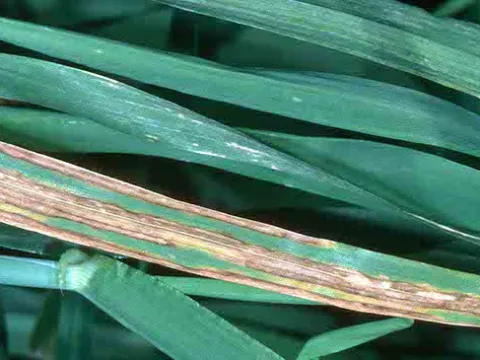
The first signs of the disease appear at the tillering stage. Characteristic narrow, longitudinal chlorotic stripes appear on the leaves, which eventually turn yellow and then brown.
As the disease progresses, the tissues of the infected leaves die and split along the veins, giving the leaves a ragged, tattered appearance, often referred to as a "shredded" look.
A typical sign is the stunting of infected plants. They often remain dwarfed, fail to head, or develop deformed and empty ears.
In high-humidity conditions, a gray mold may appear on the stripes, which is the conidial sporulation of the fungus. The leaves eventually wither, starting from the lower levels of the plant.
- Yellowing of the leaf blade along the veins.
- Longitudinal splitting of the leaf tissue.
- Severe stunting and dwarfing of plants.
- Sterility of the ear or complete lack of head formation.
The most favorable conditions for mass infection of seedlings are low soil temperatures (between 5 and 12 degrees Celsius) and high moisture levels during the sowing season.
Early sowing in cold, damp soil significantly increases the risk of barley stripe, as seedlings develop slowly, allowing the fungus more time to penetrate the tissue.
Secondary spread of conidia during the growing season requires cool and humid weather, which promotes rapid spore production and infection of adjacent plants.
The use of susceptible barley varieties, combined with a high level of seed-borne inoculum, creates ideal conditions for epidemic outbreaks of the disease.
Poor crop rotation practices and leaving infected stubble on the soil surface contribute to the accumulation of the pathogen in the agricultural ecosystem.
The economic impact of barley stripe involves significant yield reductions, which can reach 30-40% or more in years with weather conditions favorable to the fungus.
Infected plants often die before reaching the jointing stage, leading to thin stands and, in severe cases, the need for crop replanting.
The quality of harvested grain decreases sharply: it becomes shriveled, small, and has a low thousand-kernel weight, reducing its market value.
The disease impairs photosynthesis and weakens the plant's immune system, making it more susceptible to other pathogens and environmental stressors.
Since the fungus is seed-borne, using grain from infected fields as seed for the next season ensures the progression of the epidemic.
The primary method of control is the thorough treatment of seeds with systemic fungicides before planting, which effectively eliminates the internal seed-borne infection.
Adhering to optimal sowing dates is a crucial management strategy, allowing seedlings to pass the susceptible stage when the soil is warm enough for rapid development.
Using resistant or tolerant barley cultivars is the most effective and sustainable long-term solution for managing barley stripe.
Strict crop rotation, ensuring that barley is not planted in the same field for at least 2-3 years, helps to reduce the primary infection pressure significantly.
Deep plowing and incorporation of crop residues into the soil promote the breakdown of debris, reducing the survival time of the fungal inoculum.