
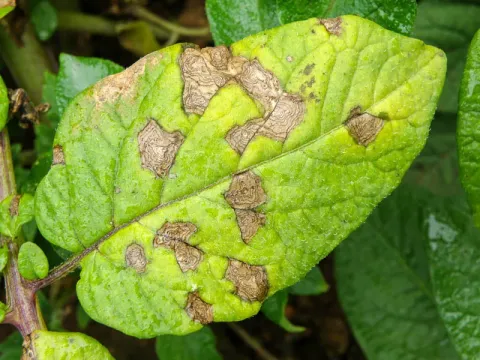
Potato early blight
Alternaria solani
The causal agent of early blight is the fungus Alternaria solani. It is a common pathogen that primarily affects the foliage and stems of potato and tomato plants, leading to significant yield losses in many growing regions worldwide.
What the section contains
Potato early blight
The fungus survives between seasons in infected plant debris left in the soil or on dormant tubers. It produces conidia that serve as the primary inoculum for new infections when environmental conditions become suitable.
Dissemination occurs primarily through wind, rain splashes, and irrigation water. The spores can travel long distances, meaning the disease can spread rapidly through an entire field within a short period.
Biologically, the fungus is highly aggressive on plants that are under physiological stress. It exploits the host's weakened state to penetrate the epidermis and initiate the infection process, forming characteristic necrotic lesions.
The life cycle is influenced by temperature and moisture, allowing the fungus to complete multiple generations of sporulation during a single growing season if the weather remains warm and humid.
The first signs of early blight typically appear on the older, lower leaves of the plant. These symptoms manifest as small, dark brown or black circular spots that gradually increase in size as the disease progresses.
A hallmark characteristic of the disease is the concentric rings within the lesion, often described as a bullseye pattern. This visual indicator helps distinguish early blight from other foliar diseases.
As the infection spreads, individual spots may merge, causing large sections of the leaf to turn yellow and necrotic. In severe cases, the entire leaf dies, leading to significant premature defoliation of the canopy.
Stem lesions may also occur, often appearing as elongated, dark necrotic areas. These lesions can weaken the stem, making the plants prone to breaking, especially during windy conditions or when carrying a heavy canopy.
Tuber symptoms include dark, sunken, and sometimes leathery lesions. Unlike late blight, the rot associated with Alternaria solani is usually firm and dry, extending into the flesh of the potato as a brown, corky decay.
Early blight thrives in warm and humid conditions. The optimal temperature range for the pathogen's development and spore germination is generally between 20°C and 28°C (68°F to 82°F).
Extended periods of leaf wetness, often caused by heavy dew, fog, or frequent rain, are critical for the fungus to penetrate the host tissues. Rapid wetting and drying cycles frequently trigger new infection events.
Plants under nutritional stress, particularly those lacking nitrogen or potassium, are much more susceptible to the disease. Proper soil fertility management is essential to maintaining the plant's natural resistance.
Poor field hygiene and high-density planting contribute to microclimates with increased humidity. These environments provide the perfect conditions for the pathogen to thrive and spread efficiently throughout the crop.
Mechanical damage caused by hail, pests, or cultivation practices creates entry points for the fungus, significantly increasing the risk of severe outbreaks in fields that have been physically stressed.
The primary harm caused by early blight is the substantial reduction of the plant's photosynthetic surface area. A smaller functional leaf area directly correlates to lower starch accumulation and reduced tuber size.
Premature senescence of the foliage stops the bulking phase of the tubers. This results in significant yield loss, as the plant fails to reach its full productive potential, often leading to a loss of 30% to 50% of the total harvest.
Tuber quality is significantly compromised, making the produce unattractive for market. The sunken lesions are entry points for secondary pathogens, leading to further storage rot and economic waste.
Increased production costs are a major consequence, as farmers must invest in repeated fungicide applications to maintain the health of the crop. This adds to the overall economic burden of potato production.
In cases of severe infection, the entire canopy can collapse, exposing the soil and increasing the risk of weed competition, which further complicates crop management and harvest operations.
Using resistant or tolerant potato varieties is the most effective long-term management strategy. Breeders have developed cultivars that show significantly lower susceptibility to Alternaria solani.
Crop rotation is vital to managing the disease. Avoiding the planting of potatoes in the same field as tomatoes or other solanaceous hosts for several years helps to deplete the population of the pathogen in the soil.
Effective sanitation practices, such as deep plowing to bury crop residues, prevent the pathogen from surviving the winter. Removing and destroying infected plant debris reduces the primary inoculum for the next season.
Maintaining optimal soil fertility, with special attention to balanced nitrogen and potassium levels, helps the plant maintain vigor and resistance. Strong, healthy plants are better able to ward off fungal infections.
Fungicide applications are a standard control measure in commercial production. Timely application, ideally starting before the onset of symptoms and based on weather monitoring, is crucial for effective disease suppression.