
Potato wart
Synchytriaceae
Description
Symptoms
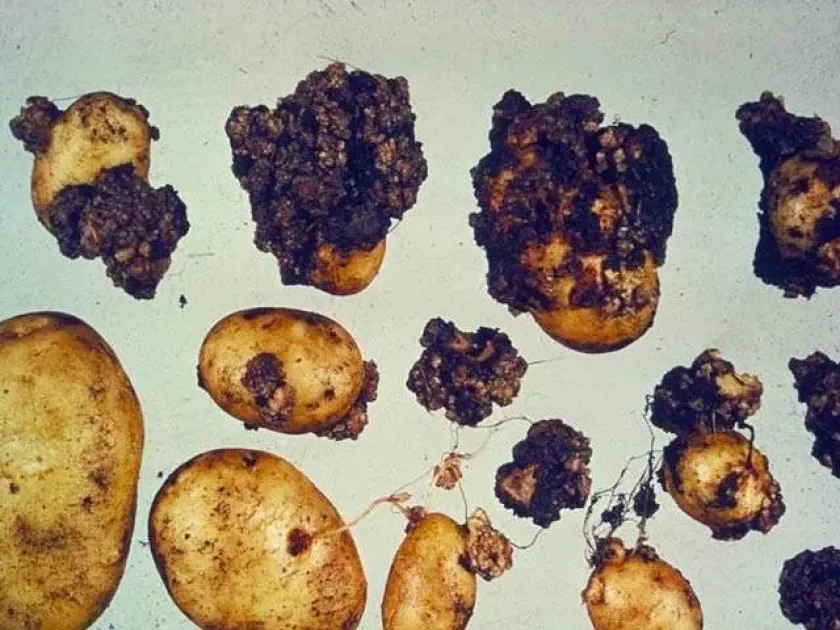
The characteristic symptom is the development of cauliflower-like outgrowths on tubers, stolons, and occasionally on the bases of stems.
Initially, these galls are flesh-colored or greenish, but they later darken, turn brown or black, and eventually rot due to secondary bacterial decomposition.
Above-ground, heavily infected plants may show signs of stunting, chlorosis, and wilting, though early infections often remain asymptomatic on the foliage.
In severe cases, the entire tuber is replaced by a mass of wart-like tissue, rendering the harvest completely unusable for both food and commercial purposes.
The degradation of tuber tissue by the disease significantly reduces the yield and compromises the marketability of any remaining healthy potatoes.
Pathogen
The causal agent of the disease is the fungus Synchytrium endobioticum, which belongs to the chytridomycete group and is a highly specialized plant pathogen.
The fungus acts as an obligate parasite, primarily attacking the tubers, stolons, and stems of potato plants, causing significant cellular hypertrophy.
The pathogen's lifecycle involves the production of motile zoospores that migrate through soil moisture to infect host plant tissues via eyes or lenticels.
The most resilient form of the fungus is the resting spore (cyst), which can survive in soil for decades, making the pathogen extremely difficult to eradicate.
Potato wart is classified as a major quarantine pest globally due to its potential to cause severe economic losses and its capacity for long-term survival in the soil.
Conditions for development
Optimal development of Synchytrium endobioticum occurs in cool, moist soil conditions with temperatures ranging from 15 to 20 degrees Celsius.
High soil moisture levels are essential for the release of zoospores, facilitating their movement to infect the young, developing tissues of potato plants.
The disease prevalence is significantly higher in acidic soils, which promote the activity and infection capacity of the fungal pathogen.
Spread of the disease over long distances primarily occurs through the movement of infested soil adhering to farm machinery, tools, or contaminated seed tubers.
Continuous cultivation of susceptible potato varieties on the same plot accelerates the buildup of resting spores in the soil environment.
Why it matters
Potato wart causes total destruction of the edible portion of the crop, leading to severe financial losses for producers and distributors.
The presence of the pathogen triggers strict local or national quarantine regulations, often prohibiting the growth of potatoes on affected land for years.
Economic damage includes not only the lost harvest but also the high costs associated with containment, decontamination, and loss of trade opportunities.
The persistence of resting spores in the soil implies a permanent risk to future crops, forcing a total change in regional land-use and agricultural practices.
The inability to use infected land for potato cultivation severely impacts the viability of farming operations in infested regions.
Protection
The primary and most effective control measure is the cultivation of potato cultivars that have been proven resistant to all known pathotypes of the fungus.
Adherence to strict phytosanitary measures, such as deep cleaning of equipment before leaving infected fields, is essential to prevent further spread.
Implementing long-term crop rotation with non-host species helps reduce the inoculum density in the soil over time.
Soil amendments, particularly liming to reduce acidity, can create a less hospitable environment for the pathogen's survival and infection processes.
Early detection and complete destruction of infected plant material, along with monitoring, are key to preventing large-scale outbreaks in new territories.
Discussion
No discussions yet — be the first.