
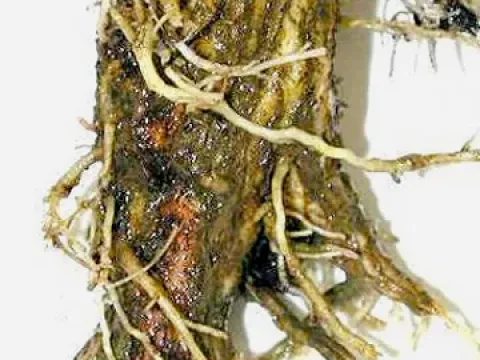
Corky root rot of lettuce
Sphingomonas suberifaciens
The primary symptom of corky root rot is the development of yellow, water-soaked lesions on the taproots and lateral roots of lettuce. Over time, these areas become thickened, brittle, and turn a distinctive brownish color, resembling a corky texture.
What the section contains
Corky root rot of lettuce
Affected root systems lose their functional capacity, leading to the decay of fine root hairs and eventually the entire root structure. In severe cases, the taproot may become completely degraded, which prevents the plant from taking up sufficient water and nutrients.
Above-ground symptoms include stunted growth and yellowing of the foliage. During warm, sunny days, infected plants often exhibit wilting, as the compromised root system cannot keep up with the plant's transpiration requirements, leading to significant yield loss.
Leaves of infected plants may show signs of chlorosis and premature senescence. In field conditions, the disease often appears in patches, where clusters of lettuce plants fail to develop uniformly compared to healthy plants in adjacent rows.
Young seedlings are particularly susceptible, often showing immediate signs of stunted development. A definitive diagnosis is typically made by inspecting the root system, which appears rigid, woody, and necrotic rather than white and healthy.
The disease is caused by the gram-negative, rod-shaped bacterium Sphingomonas suberifaciens (formerly classified as Rhizomonas suberifaciens). It is a soil-borne pathogen capable of surviving in the soil or organic debris for extended periods.
The bacterium enters the root tissues through wounds or natural openings. Once inside, it triggers a hyperplastic response in the host cells, causing the cortex to swell and undergo the characteristic corking process that gives the disease its name.
This pathogen is highly persistent and can survive in the soil even without a host crop. In greenhouse settings, the bacterium can easily spread through contaminated irrigation water, tools, soil media, and the movement of equipment between sections.
Dissemination within a farm occurs primarily through human activity. Soil particles on boots, machinery, and tools are common vectors for the bacterium. It is important to note that this disease is not transmitted via seeds.
The pathogen's life cycle is closely tied to environmental variables. Its ability to proliferate is dependent on specific soil temperatures, which explains why the disease is most prevalent during certain seasons in various geographic regions.
The development of corky root rot is strongly favored by high soil temperatures, specifically within the range of +20°C to +25°C. When soil temperatures exceed this threshold, the pathogen becomes significantly more active and aggressive.
High soil moisture and poor drainage create an environment conducive to bacterial proliferation. Waterlogged soils facilitate the movement of bacteria, allowing them to reach and infect healthy roots more effectively than in well-drained soils.
High-density planting increases the risk of disease spread within the crop canopy. Dense plantings reduce airflow and retain surface moisture, creating a microclimate that promotes the survival and transmission of Sphingomonas suberifaciens.
Soil conditions such as high salinity and low organic matter can weaken lettuce plants, increasing their susceptibility to infection. Hydroponic systems are also at risk if the nutrient solution becomes contaminated with the pathogen.
Continuous cropping of lettuce on the same land without adequate rotation leads to the buildup of high inoculum levels in the soil. Once the population of the bacterium reaches a certain threshold, successful production becomes nearly impossible without soil sterilization.
The primary economic impact of corky root rot is the reduction in marketable yield. Infected plants produce smaller heads or loose rosettes that fail to meet commercial quality standards, leading to significant financial losses for growers.
Massive mortality in seedlings can occur during early stages, necessitating replanting. For mature plants, the combination of wilting and stunted growth ruins the aesthetic appeal of the produce, rendering it unsuitable for fresh market sales.
In greenhouse operations, an outbreak can lead to the loss of an entire crop cycle. If the soil or growing medium becomes heavily infested, growers may face the high costs associated with replacing the substrate or performing complete site sterilization.
Root damage provides entry points for secondary pathogens, such as fungi and other bacteria, which can exacerbate the decline of the plant. This makes disease management more complex and less predictable than dealing with a single pathogen.
Long-term harm includes the loss of productive land use. If not managed properly, fields can become so heavily infested that they are permanently unsuitable for susceptible lettuce varieties, forcing farmers to abandon plots or switch to less profitable crops.
The most effective strategy for managing corky root rot is the use of resistant lettuce cultivars. Plant breeders have developed several varieties with genetic resistance to Sphingomonas suberifaciens, which is the primary tool for disease prevention.
Implementing a crop rotation program with a 3 to 4-year break between lettuce crops is essential to reduce the inoculum level in the soil. Rotating with non-host crops helps break the infection cycle of the bacteria.
Thermal treatments, such as soil solarization or steam sterilization, are highly effective in reducing pathogen populations in greenhouse soils. Additionally, applying bio-control agents can help manage soil health and suppress bacterial activity.
Managing the growing environment is crucial. Keeping soil temperatures as low as possible and ensuring excellent drainage can inhibit the rapid development of the disease. Careful management of irrigation systems prevents the spread of the pathogen through water.
- Sanitize all tools and equipment between different production areas;
- Use only certified disease-free substrate for seedling production;
- Promptly rogue and destroy any infected plants and associated root debris;
- Maintain proper plant spacing to ensure good air circulation and surface drying.