
Description
Symptoms
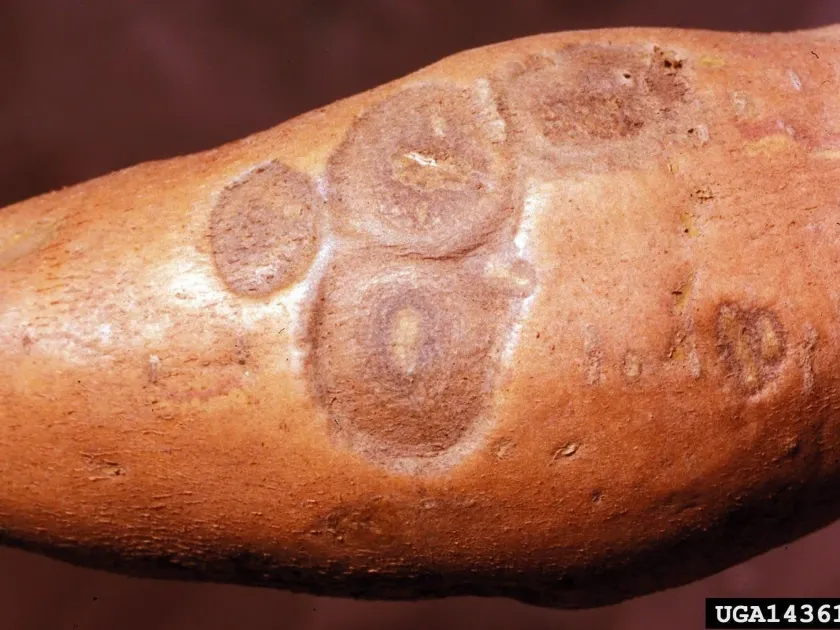
Symptoms of soil rot initially manifest on the roots and small developing tubers. Growers may observe brown to black sunken lesions that gradually expand into large, distorted sores on the skin of the tubers.
The root system exhibits severe damage: roots become necrotic, brittle, and dark, often failing to sustain the nutrient uptake required for vigorous foliage growth. This leads to stunted plant growth, yellowing leaves, and general lack of plant health.
At the tuber surface, the damage appears as rough, corky patches or crater-like lesions. These lesions often have jagged edges and are deep enough to cause significant structural deformation of the sweet potato tuber.
In the field, infested areas are characterized by irregular patches of poor growth. Plants in these zones exhibit chlorosis and wilting, especially during hot afternoon hours, as their damaged root systems cannot keep up with transpiration demands.
While the internal flesh of the sweet potato may remain firm initially, these surface lesions eventually predispose the tuber to secondary fungal and bacterial decay during the storage period, ruining the harvest quality.
Pathogen
The causal agent of sweet potato soil rot is the actinomycete Streptomyces ipomoeae. It is a soil-borne bacterium that creates a complex network of filaments, functioning similarly to a fungal mycelium to invade plant host tissues.
This pathogen is highly resilient and capable of surviving in the soil for several years by utilizing organic matter, making it a persistent threat to agricultural fields where sweet potatoes are grown continuously.
Infection primarily occurs through the root system. The bacterium colonizes lateral roots, causing lesions that eventually lead to the necrosis of the primary root system and the development of deep sores on the expanding tubers.
Streptomyces ipomoeae is transmitted primarily through contaminated soil transported by machinery or foot traffic. Furthermore, the use of infected sweet potato slips as planting material is a major pathway for introducing the pathogen to clean fields.
The biology of this organism is adapted to survive in various environments, and it effectively persists in the soil profile, creating a long-term reservoir of infection that is difficult to eradicate once established.
Conditions for development
The development of soil rot is heavily dependent on soil pH. Streptomyces ipomoeae thrives in neutral to alkaline soils, with an optimal pH range between 6.5 and 8.0, where it is most aggressive.
Temperature plays a crucial role in the disease cycle, with the bacterium becoming significantly more active at soil temperatures ranging from 20 to 30 degrees Celsius, which is optimal for sweet potato development.
Moisture levels influence the spread of the pathogen. While the bacteria can survive dry conditions, high soil moisture following heavy rainfall facilitates the movement of the inoculum through the soil and into contact with healthy roots.
Continuous cropping of sweet potatoes creates an ideal environment for the pathogen to multiply. When the same crop is grown annually, the soil ecosystem becomes unbalanced, favoring the survival and increase of Streptomyces ipomoeae populations.
Field practices, such as deep tillage or soil compaction, can affect the incidence of the disease. Any factor that stresses the plant or causes mechanical damage to the roots provides easy entry points for the actinomycetes.
Why it matters
The economic impact of soil rot is substantial due to the direct destruction of the marketable crop. Infected tubers are often visually unappealing and have reduced nutritional value, making them unsuitable for fresh market sales.
Yield loss can be catastrophic, with some fields reporting significant reductions in total tonnage. Because the pathogen affects the roots, the plant's ability to store energy is severely hindered, resulting in small, malformed tubers.
Beyond field losses, the storage life of infected tubers is severely compromised. Lesions allow opportunistic pathogens to enter the tuber, leading to total decay of the harvest within a few months of storage.
The presence of soil rot can force growers to abandon specific fields or undergo costly soil sanitation programs. This limits land availability and increases production costs, negatively affecting the profitability of the entire farm operation.
Due to the long-term survival of the bacterium in the soil, growers face management challenges for years after an outbreak. This requires rigorous quarantine of the affected land and careful inspection of all farm equipment moving between fields.
Protection
The most effective management strategy is a long-term crop rotation. By planting non-host crops for 4 to 5 years, growers can effectively reduce the population density of Streptomyces ipomoeae in the field soil.
Soil pH management is a critical tool. Maintaining soil acidity at a pH level of 5.0 to 5.5 can significantly inhibit the growth of the pathogen, as the bacterium struggles to survive or infect roots in acidic soil conditions.
- Utilizing only disease-free planting material from certified sources.
- Implementing strict sanitation protocols for equipment, tools, and footwear.
- Selecting sweet potato varieties that exhibit natural field resistance.
- Improving soil drainage to minimize moisture stress for the crop.
The application of organic amendments, such as compost or green manure, can promote a healthy microbiome. A diverse soil community can provide natural competition against Streptomyces ipomoeae, helping to suppress its growth.
Immediate removal and destruction of crop residues after harvest are essential to reduce the amount of inoculum returned to the soil for the next season. Avoiding the movement of infested soil is paramount to protecting clean areas of the farm.
Pathogens and affected parts
Affects crops · 1
Discussion
No discussions yet — be the first.