
Description
Symptoms
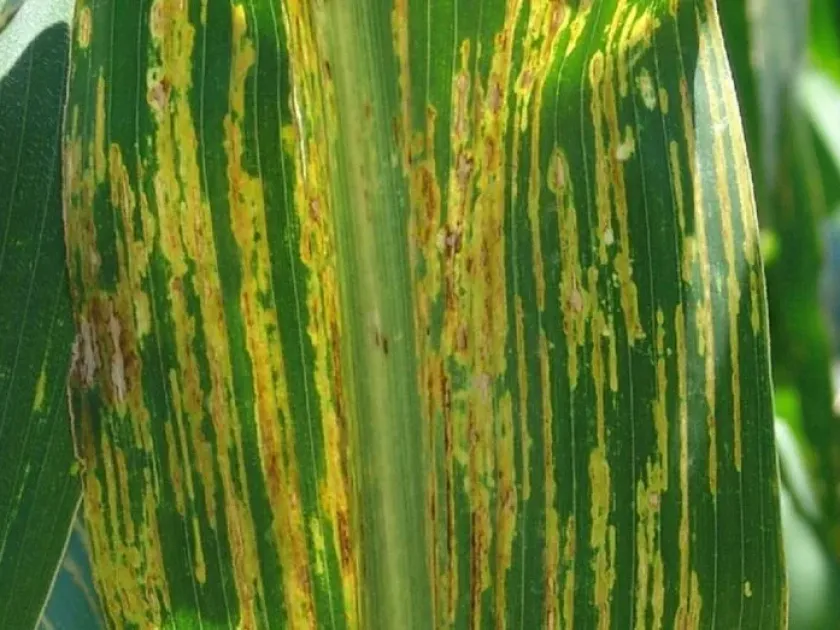
Early symptoms appear as long, pale-green or yellow stripes with wavy, irregular margins that follow the leaf veins.
As the disease progresses, these stripes become necrotic, turning brown and causing the leaves to wither and die prematurely.
Young plants may exhibit severe wilting, stunting, or even death, particularly in highly susceptible hybrids.
Affected adult plants often show poor ear development, leading to smaller cobs or total lack of grain filling.
- Wavy-margined chlorotic lesions
- Bacterial ooze from cut stems
- Systemic stunting of plants
Pathogen
The causal agent of the disease is the bacterium Pantoea stewartii subsp. stewartii. It is a gram-negative pathogen that causes systemic infections in maize.
The bacteria colonize the xylem vessels of the plant, producing extracellular polysaccharides that physically obstruct the movement of water and nutrients.
The corn flea beetle, Chaetocnema pulicaria, acts as the primary vector for the bacterium. The pathogen overwinters inside the insect's digestive tract.
Transmission occurs when the beetles feed on leaves, introducing the bacteria into the plant's vascular system through the feeding wounds.
Seed transmission is also possible and plays a role in long-distance spread, though beetle activity is the major cause of seasonal epidemics.
Conditions for development
The survival of the vector, the corn flea beetle, is heavily dependent on winter temperatures. Mild winters lead to higher beetle populations and increased disease risk.
Warm and humid weather during the growing season accelerates the colonization and multiplication of the bacteria within the host.
High insect feeding pressure during the early vegetative growth stages of corn significantly increases the infection rate.
Susceptible hybrids are much more prone to rapid systemic spread of the bacterium, especially under heat stress conditions.
Moisture stress can exacerbate the symptoms of wilt, as the plant's vascular system is already compromised by bacterial plugging.
Why it matters
Stewart's wilt can cause massive yield losses, sometimes exceeding 50% in highly susceptible corn varieties.
Grain quality is often severely impacted, resulting in low test weight and reduced market value for the harvest.
In cases of severe early-season infection, entire corn fields may be lost, forcing farmers to replant at significant expense.
Infected plants are weakened, becoming highly vulnerable to secondary infection by stalk rot pathogens, which leads to lodging.
The disease poses significant quarantine challenges for seed production, restricting international trade of potentially contaminated lots.
Protection
The most effective strategy is planting resistant or tolerant corn hybrids, which minimize the impact of the disease.
Seed treatment with systemic insecticides is crucial to protect young seedlings from early-season feeding by flea beetles.
Foliar application of insecticides may be necessary in areas with high beetle populations to reduce the number of potential vectors.
Integrated pest management, including weed control and crop rotation, helps reduce the localized habitat of the overwintering beetles.
Field scouting for early symptoms is vital to determine the need for therapeutic intervention and to manage the spread within the farm.
Pathogens and affected parts
Affects crops · 1
Discussion
No discussions yet — be the first.