

Description
Symptoms
The most distinctive sign of Eastern filbert blight is the formation of elongated, sunken, or raised cankers on the bark of twigs and branches.
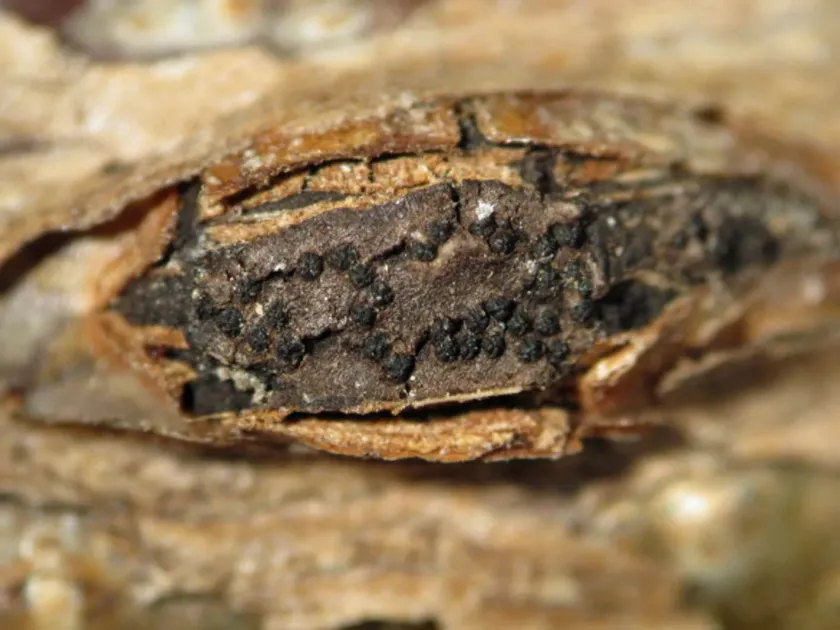
As the disease progresses, these cankers become covered with rows of black, pimple-like fruiting bodies. These stroma erupt through the bark, releasing spores.
Branches distal to the canker site show signs of wilting and dieback. In late summer or autumn, leaves on infected branches may turn yellow and wither prematurely.
Once the infection girdles a branch, the entire limb dies. Over time, the tree canopy becomes thin, and the tree may eventually die if the infection reaches the main trunk.
In the dormant season, the black, pustule-like fruiting structures are most easily visible against the smooth bark of the twigs, which aids in early detection.
Pathogen
The causal agent of this serious disease is the ascomycete fungus Anisogramma anomala. It is a highly specialized pathogen that exclusively affects plants of the Corylus genus.
The fungus has a two-year life cycle. During this period, it colonizes the bark and cambium of the hazelnut tree, effectively cutting off the tree's internal circulation system.
Infection begins when ascospores are released and spread by wind and rain. They settle on young shoots, germinating in the presence of moisture to penetrate the plant tissues.
The pathogen is highly aggressive and remains active within the wood throughout the year. Its ability to produce spores over long periods makes it an extremely difficult disease to manage.
Due to its potential to devastate entire plantations, Anisogramma anomala is classified as a quarantine organism in many hazelnut-growing regions globally.
Conditions for development
The spread of Anisogramma anomala is heavily influenced by environmental conditions, particularly high humidity during the spring infection window.
Frequent spring rain showers and heavy fogs are ideal for spore dispersal. These conditions allow spores to germinate rapidly when they land on susceptible hazelnut shoots.
Mechanical injuries from pruning, wind, or insect damage provide entry points for the fungus, making the tree more vulnerable to initial colonization.
Dense orchard spacing restricts airflow, resulting in prolonged leaf and twig wetness. This microclimate significantly favors the survival and spread of the pathogen.
Lack of proper canopy management, such as failing to thin trees, leads to an accumulation of fungal spores within the orchard environment.
Why it matters
Eastern filbert blight is lethal to hazelnut trees. Once the fungus enters the woody tissues, it effectively creates a systemic blockage that the tree cannot overcome.
The primary economic impact is the progressive death of branches, leading to a total loss of nut production and eventual tree mortality if left untreated.
Rapid spread of the disease means that a single infected tree can quickly become a source of inoculum for the entire plantation, necessitating large-scale eradication.
Costs related to tree removal, pruning, and intensive fungicide applications create a significant financial burden for commercial growers.
The disease forces growers to abandon susceptible cultivars, limiting genetic diversity and requiring investments in more resistant but potentially lower-yielding varieties.
Protection
The cornerstone of management is rigorous pruning. Infected branches must be removed at least 30 to 50 centimeters below the visible canker and destroyed immediately.
Preventative fungicide applications are essential. Copper-based sprays or other systemic fungicides should be applied regularly during the spring to protect healthy tissues.
Only source nursery stock from reputable providers and ensure that the plants are certified disease-free to prevent the introduction of the pathogen to your site.
- Select resistant hazelnut cultivars.
- Sanitize pruning tools between cuts using alcohol or bleach.
- Remove wild hazelnut bushes from the vicinity of the orchard.
- Ensure adequate orchard spacing to promote airflow.
Regular scouting is critical. Inspecting the orchard during the winter months allows for the early removal of infected branches before the spore release season starts in spring.
In brief
1
Affects crops
Biology
Pathogens and affected parts
Pathogens
Affected plant parts
whole plant
Content graph
Affects crops · 1
Content graph
Connections · Eastern filbert blight
Most often together:
Marketplace
Products · 3


Community
Discussion
No discussions yet — be the first.