

Black root rot
Thielaviopsis basicola
Description
Symptoms
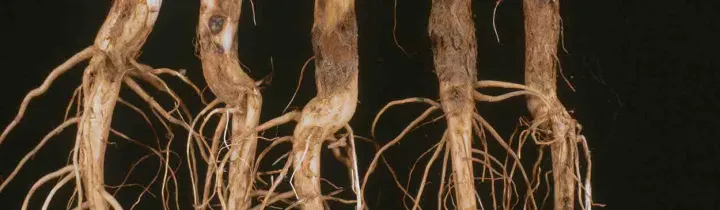
The most distinctive symptom of black root rot is the presence of black, necrotic lesions on the roots, which give the disease its name.
Above-ground symptoms are non-specific and include stunted growth, chlorosis, and wilting, which often leads to misdiagnosis as nutrient or water deficiency.
In advanced stages, the root system becomes severely reduced and discolored, often resulting in complete rot of the lateral and primary roots.
For seedlings or small plants, the disease can cause a blackening of the stem base near the soil line, commonly known as black leg or root rot.
When infected plants are pulled from the soil, the root systems frequently break apart, leaving damaged and decayed root tissue behind in the soil.
Pathogen
The causal agent of black root rot is the soil-borne fungus Thielaviopsis basicola (syn. Chalara elegans). It is a persistent pathogen with a very wide host range.
The fungus produces two types of spores: endoconidia for rapid dissemination and chlamydospores, which allow the fungus to survive in the soil for several years.
Thielaviopsis basicola infects plants by penetrating the root cortical cells, often utilizing existing wounds or root hair entry points to colonize the plant.
Once established, the pathogen colonizes the root tissue, disrupting the vascular system and preventing the uptake of water and nutrients.
The fungus is highly resilient and can persist in soil, irrigation water, and on infected plant debris, making long-term field management complex.
Conditions for development
Black root rot is most prevalent in cool to moderate soil temperatures, typically favoring ranges between 15°C and 22°C.
High soil moisture and poor drainage significantly increase the risk of infection and the rate at which the fungus spreads through the root zone.
The fungus thrives in neutral to alkaline soils; therefore, maintaining a slightly acidic soil pH is a standard cultural practice to suppress its growth.
Greenhouse environments with low air circulation and consistent overwatering provide ideal conditions for the rapid multiplication of the pathogen.
Plants under stress from improper environmental conditions, overcrowding, or nutrient imbalance are significantly more susceptible to Thielaviopsis.
Why it matters
The disease causes substantial economic loss by reducing crop yield, plant vigor, and marketability of nursery stock.
Black root rot affects a diverse array of plants, including important crops like cotton, citrus, watermelon, and various ornamental species like cyclamen and fuchsia.
Severe infestations can lead to complete stand failure in vegetable and flower production, necessitating significant investment in decontamination.
Because the chlamydospores can persist for years, once a field is contaminated, it may become unsuitable for sensitive crops for an extended duration.
The disease weakens the host plant's resistance, opening the door for opportunistic secondary pathogens to further exacerbate the damage.
Protection
Implementing a robust rotation plan that avoids host crops for at least 3 to 5 years is the most effective way to manage the pathogen in the field.
Sanitation is critical; all tools, pots, and greenhouse benches must be thoroughly disinfected to prevent the spread of soil particles.
- Monitor and adjust soil or substrate pH to a slightly acidic level (below 6.0).
- Ensure excellent drainage and avoid overwatering susceptible crops.
- Use pathogen-free certified seeds and transplants from reputable sources.
- Apply biocontrol agents such as Trichoderma harzianum to protect the roots.
In highly intensive systems, professional-grade fungicides may be used as a soil drench or pre-plant treatment to reduce inoculum levels in the growing media.
In brief
18
Affects crops
Biology
Pathogens and affected parts
Pathogens
Thielaviopsis basicola· fungus
Chalara elegans· fungus
Xylaria mali· fungus
Xylaria polymorpha· fungus
Rosellinia bunodes· fungus
Ceratobasidium· fungus
Coniothyrium fuckelii· fungus
Diapleella coniothyrium· fungus
Leptosphaeria coniothyrium· fungus
Hainesia lythri· fungus
Discohainesia oen· fungus
Idriella lunata· fungus
Affected plant parts
root
Content graph
Affects crops · 18
Content graph
Connections · Black root rot
Most often together:
Marketplace
Products · 11
Community
Discussion
No discussions yet — be the first.