
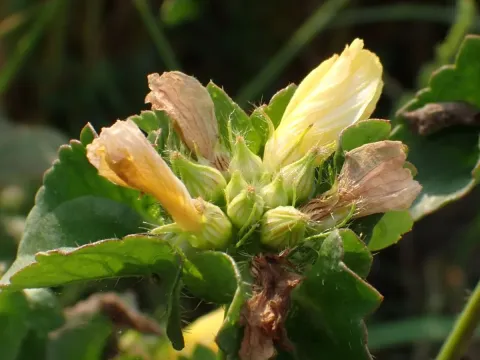
Urena lobata
Urena capitata
Sowing Urena lobata, commonly known as Caesarweed or Congo jute, is performed when soil temperatures consistently reach +15...+18°C. In tropical and subtropical regions, the start of the rainy season provides the ideal moisture levels for germination.
What the section contains
Urena lobata
Seeds are sown in rows spaced 30 to 45 cm apart. The planting depth is usually kept between 2 and 3 cm, depending on the soil texture, as the small seeds require shallow placement to ensure successful emergence.
Field preparation is crucial, as the initial growth phase of Urena lobata is relatively slow. Removing weeds prior to and during the early weeks of crop development is necessary to prevent competition for nutrients and sunlight.
Seeding rates are adjusted based on the intended use of the fibers. Higher plant density is preferred for commercial fiber production to encourage elongation of the main stems and reduce lateral branching.
In regions prone to dry spells, irrigation systems are recommended during the first weeks after sowing, as the young seedlings are highly sensitive to drought until the root system is established.
Urena lobata is a member of the Malvaceae family and thrives in tropical climates with stable high temperatures, typically between +25°C and +30°C. It is intolerant of frost and extreme cold.
The plant requires deep, fertile, and well-drained loamy soils. It cannot tolerate waterlogging, which rapidly leads to root decay and significant plant loss, making proper field drainage an absolute necessity.
As a short-day plant, Urena lobata reacts to photoperiod changes. Choosing the right cultivar for the specific latitude is essential to ensure that the plant reaches its vegetative peak at the correct time.
Soil pH levels should be maintained in the range of 6.0 to 7.0 for optimal growth. If the soil is too acidic, liming is required to improve nutrient availability and ensure healthy biomass production.
The crop responds well to nitrogen-rich fertilization, which supports rapid stem development. Balanced NPK application is recommended to achieve the high biomass yields required for industrial fiber extraction.
The yield of Urena lobata depends on site-specific soil fertility and management practices. Well-managed plantations can produce between 4 to 6 tonnes of dry fiber per hectare under optimal conditions.
Following harvest, the stems undergo a retting process to separate the bast fiber from the woody core. The quality and strength of the final fiber depend on the control and duration of this biological process.
Ongoing breeding efforts focus on selecting varieties that exhibit minimal branching. By reducing side branches, producers can harvest more uniform, high-quality stalks that are easier to process into textiles.
The fiber derived from Urena lobata is prized for its high tensile strength and resistance to decay, making it a viable sustainable alternative to other common bast fibers like jute or kenaf.
Modern mechanization of the harvesting and processing stages has significantly increased the economic feasibility of cultivating this crop, allowing for more efficient yield collection.
The crop is vulnerable to various pests, particularly aphids and leaf-eating beetles, which target the foliage during the early stages of growth and can stunt development if left uncontrolled.
Root rot is a major threat in fields with inadequate drainage. Fungal pathogens thrive in saturated soil, leading to rapid decay of the root system and large-scale plant death in affected areas.
Leaf diseases, such as anthracnose, are common in humid conditions with poor airflow. Maintaining proper plant spacing helps to lower humidity levels around the stems and reduces the spread of fungal spores.
Nematodes are another concern in specific soil types, as they attack the roots and reduce the overall vigor of the crop, directly impacting the final stem yield and quality.
- Implementing a strict crop rotation schedule to break the lifecycle of soil-borne pests.
- Monitoring fields frequently for signs of insect damage to enable early chemical intervention.
- Using appropriate fungicides to manage fungal outbreaks in warm, humid weather.
Harvesting Urena lobata is typically performed at the onset of flowering. At this stage, the plant has achieved maximum biomass, and the fiber quality is at its peak before the stems become overly lignified.
Delayed harvesting leads to the maturation of the stem fibers, which makes them coarser and harder to process. This results in lower-grade fiber that is less suitable for fine textile applications.
Mechanized mowers are used to harvest the stalks close to the ground. The stalks are gathered into bundles for transport to retting pits or industrial processing facilities.
Retting—the process of soaking the stems in water—allows the fibers to loosen from the stem's woody tissues. Temperature control is critical during this phase to ensure consistent fiber characteristics.
After retting, the fiber is cleaned of woody residue (shiv), dried, and pressed into large bales. This compact packaging is essential for cost-effective transport to spinning mills and industrial manufacturers.