
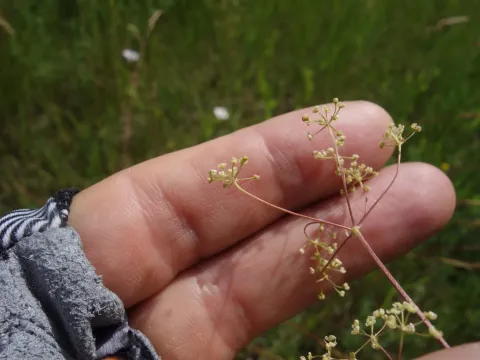
Trinia ramosissima
Trinia ramosissima
Trinia ramosissima belongs to the Apiaceae family. It is a perennial herbaceous plant recognized for its delicate foliage and branched growth habit.
What the section contains
Trinia ramosissima
The sowing process typically takes place in early spring. Seeds require a cool period to break dormancy, making stratification an essential step for high germination rates.
Seeds should be planted at a shallow depth of approximately 1–2 cm. Proper spacing is crucial, with row intervals of 30–45 cm to ensure adequate space for mature plant development.
During the first year, growth is concentrated on the root system and the development of a basal leaf rosette. The plant shows slow initial progress but establishes a strong foundation.
Once established, the plant thrives through seed dispersal and vegetative propagation, adapting well to its specific niche in the environment.
The species prefers well-lit areas with full sun exposure. It is sensitive to shade, which can lead to elongated stems and a reduction in overall plant vigor.
Soil requirements include excellent drainage and a high calcium content. Waterlogged soils are detrimental to this species and must be avoided to prevent root diseases.
A neutral to slightly alkaline soil pH is optimal for the growth of Trinia ramosissima. Sandy or calcareous soils mimic the natural habitat where this plant thrives.
The plant is highly drought-tolerant, making it an excellent candidate for regions with limited rainfall. Its deep root system allows it to withstand extended dry periods.
General management involves routine weeding and light soil cultivation to improve aeration, which supports the healthy growth of the root system.
Root rot is the most common threat to Trinia ramosissima, particularly when grown in heavy, poorly drained clay soils that retain excessive moisture.
Pests such as aphids and specialized coleopterans may attack the plant, especially during the flowering stage when the plant is most vulnerable.
To maintain plant health, it is recommended to practice crop rotation, ensuring that the ground is not used for related Apiaceae species consecutively.
Integrated pest management, including the use of biological control agents, is effective in maintaining the health of the crop without damaging the ecosystem.
Regular inspection of leaves and stems allows for early detection of potential infestations, enabling rapid response to mitigate significant damage.