
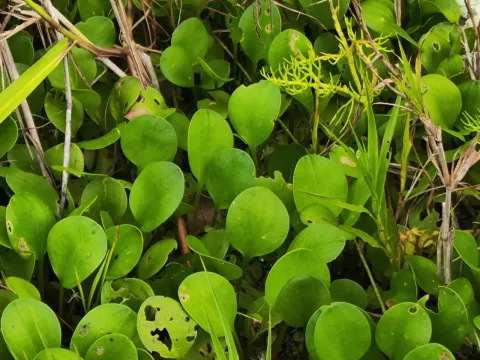
Limnobium laevigatum
Limnobium laevigatum
Limnobium laevigatum, commonly known as Amazon frogbit, is an aquatic floating plant belonging to the Hydrocharitaceae family. Originating from South and Central America, it is widely recognized for its floating rosettes of thick, succulent-like leaves.
What the section contains
Limnobium laevigatum
The plant features long, feathery roots that dangle into the water column. These roots serve as a primary system for absorbing nutrients, making the plant an efficient biological filter for nitrogenous compounds.
Optimal growth requires water temperatures between 20 °C and 28 °C. Light intensity is a critical factor; while it can survive in moderate light, intense illumination promotes the growth of compact rosettes, whereas low light leads to elongated stems.
The species prefers neutral to slightly acidic water (pH 6.0–7.5). It is highly adaptable to various water hardness levels but requires consistent micronutrients, specifically iron, to maintain healthy green coloration in its leaves.
In cultivation, air humidity and ventilation are important when growing the plant in covered tanks. Constant contact with glass covers or high-humidity condensation can lead to leaf tissue necrosis.
Limnobium laevigatum is commercially produced for the aquarium trade and pond ornamental markets. Its primary value lies in its fast reproductive rate, where the plant produces offsets or runners that quickly multiply into new rosettes.
From an agricultural standpoint, yield is measured by the biomass accumulation rate. Under ideal conditions with high light and nutrient-rich water, the plant can cover a significant surface area in a matter of weeks, allowing for frequent harvesting.
The plant serves as a functional decorative element, providing shelter for fry and fish. Its dense root system acts as a natural nursery, protecting juvenile organisms from predators while stripping the water of toxic wastes.
Recent interests in phytoremediation suggest that this species can be used in waste-water treatment systems. Its rapid growth allows for the uptake of excessive nitrates and phosphates, which would otherwise contribute to algae blooms.
Commercial producers manage stock by thinning out the biomass, ensuring that light can still penetrate the water column for the remaining plants to maintain maximum growth efficiency.
Fungal pathogens are the most common threat to Limnobium laevigatum, especially if leaves become damaged or damp on the top surface. Once a leaf starts to rot, the decay can rapidly spread to the entire plant cluster.
Pests such as aphids can be a major issue, especially in greenhouse or outdoor pond settings. They cluster on the underside of the leaves and stems, sucking the sap and causing the foliage to curl and yellow.
Due to its rapid growth, the plant is considered invasive in certain warm climates. Its ability to form dense mats can effectively block sunlight, damaging submerged ecosystems and disrupting gas exchange at the water-air interface.
Sensitivity to chemical water treatments is another challenge. Many products used to treat fish diseases, particularly those containing copper or strong algaecides, can be lethal to the plant, causing rapid yellowing and dissolution.
Nutrient deficiencies, particularly iron or potassium, are common threats in managed systems. Lack of these minerals leads to chlorosis, weakening the plant's immune system and making it susceptible to opportunistic bacteria.