
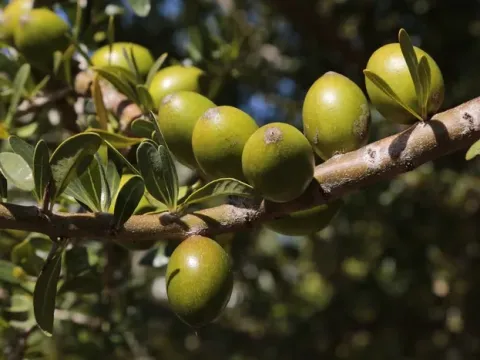
Argan tree
Argania
The Argan tree (Argania spinosa) belongs to the Sapotaceae family. It is a long-lived, evergreen species native to the arid and semi-arid southwestern regions of Morocco, where it thrives in challenging ecological conditions.
What the section contains

Argan tree
The species is renowned for its remarkable drought tolerance. It utilizes an extensive root system to reach deep soil moisture, allowing it to survive in environments where rainfall is extremely scarce and sporadic.
Regarding soil conditions, Argania prefers sandy or limestone-based soils with excellent drainage. It is highly sensitive to waterlogging, making proper site selection a critical factor for successful plantation establishment.
Botanically, the tree features a dense, thorny canopy that serves as a natural defense mechanism. The leaves are small and leathery, which minimizes transpiration, a key adaptation to the high temperatures and intense sunlight of the region.
Economically, the tree is primarily grown for its seeds, which are processed to produce argan oil. This oil is a premium product in both the food and cosmetic industries due to its high concentration of vitamin E and essential fatty acids.
One of the primary threats to Argan forests is overgrazing by goats and other livestock, which browse on young shoots and prevent natural regeneration of the species in many traditional growing areas.
Pests that affect the tree include various insect species, such as fruit borers, which can damage the developing kernels and significantly reduce the total yield of the argan oil harvest.
Disease pressure in Argan trees is often linked to soil moisture management. When trees are planted in poorly drained areas, they become susceptible to root rot and other soil-borne fungal pathogens.
Standard agrotechnical practices for protection involve fencing off young seedlings from livestock and monitoring the orchard for signs of insect infestation or canopy distress during the hot summer months.
Conservation efforts are crucial, as the Argan forest is recognized as a vital ecosystem. Sustainable management practices, such as community-based harvesting, are essential to ensure the longevity of these unique agroforestry systems.