
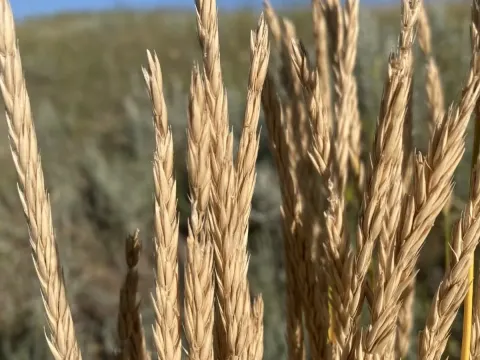
Psathyrostachys
Psathyrostachys
The optimal sowing time for Psathyrostachys is early spring, as soon as the soil physically warms up to 5-8 degrees Celsius. Winter sowing is also acceptable, often resulting in more uniform germination due to the natural stratification of seeds.
What the section contains

Psathyrostachys
The sowing depth should not exceed 2-3 centimeters, as the seeds are quite small. When sowing in light sandy soils, it is important to ensure surface rolling to retain moisture in the germination horizon.
The seeding rate varies significantly depending on the purpose: it is usually higher for hayfields than for pastures. On average, 8 to 12 kilograms of high-quality seed material are used per hectare.
Psathyrostachys is characterized by slow growth in the first year, so minimizing weed competition during the early stages is crucial. Timely mowing of weeds helps young plants strengthen and develop a robust root system.
To speed up germination, it is recommended to treat seeds with growth stimulants or keep them in a moist environment before sowing. This allows the crop to pass through critical developmental stages faster under water-stressed conditions.
The crop belongs to the Poaceae family and is a typical xerophytic plant. Psathyrostachys possesses exceptional drought tolerance and the ability to withstand extreme temperatures, making it indispensable in arid regions.
The plant prefers well-aerated sandy, loamy, and rocky soils but also thrives on saline lands. High salt tolerance allows Psathyrostachys to be used for the phytoremediation of degraded solonchak soils.
The root system is powerful and penetrates deep into the soil profile, allowing the plant to effectively extract moisture from lower horizons. This feature ensures the longevity of the stand even during prolonged heatwaves and dry spells.
Psathyrostachys is extremely sensitive to waterlogging and high water tables, making it unsuitable for river floodplains or heavy clay soils. Water stagnation leads to the rapid decline and death of the plant stand.
In its natural habitat, the crop's range covers the steppes and semi-deserts of Eurasia, where it acts as a dominant species in plant communities. It effectively stabilizes shifting sands, preventing soil erosion.
The biomass yield of Psathyrostachys directly depends on the moisture level of the season and soil fertility. In favorable years with sufficient rainfall, the crop can provide two full harvests within a single growing season.
Under irrigation, grass productivity increases significantly, although the economic feasibility of watering this crop is often limited. On average, hay yields range from 1.5 to 3 tons per hectare depending on the site conditions.
To obtain high seed yields, the stand should be left standing until full maturity, which usually occurs in mid-summer. Seed productivity can range from 200 to 500 kilograms per hectare with proper agronomy.
Regrowth capacity is moderate, but after mowing, Psathyrostachys grows back relatively quickly, forming a dense stand. This allows for intensive livestock grazing during early spring and late autumn periods.
With systematic pasture management, the yield of Psathyrostachys remains stable for 7-10 years. After this period, the stand usually requires rejuvenation through disking or overseeding with legume components.
Psathyrostachys possesses a high level of natural resistance to most pathogens that affect agricultural grasses. Pests rarely cause significant economic damage due to the tough, fibrous structure of its leaves.
In occasionally wet years, outbreaks of fungal diseases such as rust or powdery mildew may appear on the foliage. Management focuses on maintaining appropriate grazing schedules and preventing overcrowding of the stand.
Among pests, cereal flies and seed-eating insects can pose the greatest threat by damaging the reproductive organs during the flowering period. Monitoring pest populations allows for timely protective measures in seed production fields.
Root system pests, such as white grub larvae, can cause localized damage in older stands. When pest populations exceed economic thresholds, biological or chemical control measures are applied according to regulations.
Failure to adhere to grazing norms negatively impacts the health of the stand. Overgrazing leads to plant stress, depletion of energy reserves, and subsequent encroachment by weeds that can displace the crop from the agroecosystem.
Hay harvesting is conducted during the heading phase when the nutritional value is at its peak and fiber content has not yet reached critical levels. Early mowing ensures high-quality forage for cattle.
To accelerate drying, the mown biomass should be left in windrows until optimal moisture is reached. Psathyrostachys is characterized by rapid moisture loss, which minimizes risks when harvesting hay during dry weather.
During seed harvesting, timing is critical to prevent shattering. Since the spikelets are prone to breaking upon maturity, harvesting should be done when most inflorescences turn yellow, using combine harvesters with reduced drum speed.
For long-term storage, the hay is pressed into bales or rolls and stored in dry, well-ventilated areas. Properly harvested Psathyrostachys hay stores well and is highly palatable to livestock during winter.
After seed harvesting, the remaining straw can be used as roughage for adult animals or as bedding material. Often, post-harvest residues are left in the field to trap snow and improve soil structure.