
Four-leaf mare's tail
Hippuris tetraphylla
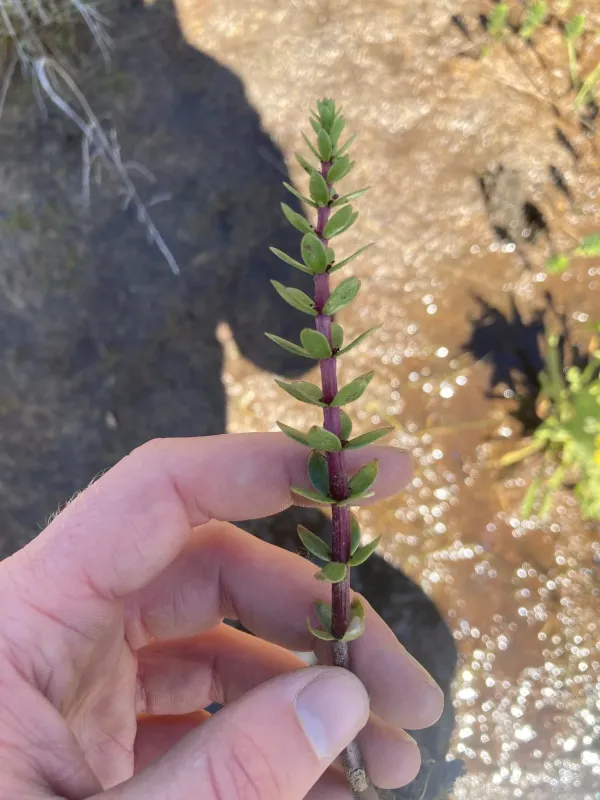
Description
Growing requirements
Hippuris tetraphylla, known as the four-leaf mare's tail, belongs to the Plantaginaceae family. This perennial herbaceous plant is specialized for survival in the harsh conditions of arctic and subarctic coastal zones.
It is a halophyte, meaning it is adapted to grow in saline soils. The plant is typically found in river estuaries, along the banks of marine bays, salt marshes, and silty flats where the water salinity fluctuates due to tidal influence.
Botanically, it presents an erect stem with whorled leaves. Unlike its close relative, the common mare's tail (Hippuris vulgaris), this species usually features leaves grouped in whorls of four, which is reflected in its scientific and common names.
The plant has specific climatic requirements, being fully adapted to the short northern summer. It exhibits extreme frost resistance but requires constant moisture throughout the growing season to thrive.
It prefers silty or sandy-silty substrates rich in organic matter. Reproduction occurs mainly through vegetative propagation via rhizomes, allowing the plant to form dense clusters in its natural environment.
Yield
Hippuris tetraphylla is not cultivated as a traditional agricultural crop, so standardized yield metrics do not exist. In its natural state, biomass production varies significantly depending on salinity stress and the duration of the growing season.
The plant has limited economic use, primarily serving as a natural forage source for reindeer during the summer months and providing critical habitat for various waterfowl species nesting in coastal areas.
A key ecological role of the plant is coastal stabilization. Its root system acts as a natural stabilizer, binding sediments and preventing soil erosion during high tides and seasonal flooding.
The thickets of four-leaf mare's tail create unique micro-ecosystems that support various small crustaceans and juvenile fish, making it an essential component of the coastal biocenosis.
Future use of this species in agro-industrial contexts might focus on phytoremediation strategies for disturbed saline lands in arctic regions where traditional crops cannot survive.
Main diseases and pests
Hippuris tetraphylla shows high resistance to the natural negative factors of northern latitudes. The primary threats to the species are anthropogenic, particularly chemical and oil pollution in marine estuaries.
Any disruption to the hydrological regime in its growth area, such as port infrastructure development, can lead to the irreversible loss of local populations of this plant.
Climate change, accompanied by rising sea levels, poses a risk of flooding its natural habitats, where the plant may struggle to compete with other invasive or encroaching species.
No specific pests of significant economic importance have been identified, as the plant is evolutionarily adapted to the limited spectrum of insects found in the tundra zone.
When attempting artificial propagation, it is critical to control soil salinity levels, as excessive salt concentrations can inhibit photosynthesis and hinder the development of the root system.