
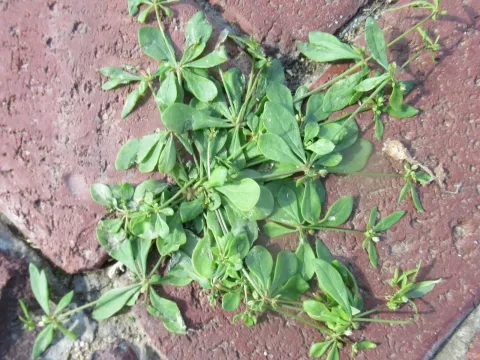
Carpetweed
Mollugo
Carpetweed (Mollugo verticillata) is an annual herbaceous plant widely recognized as a common weed in agricultural fields. Seeds typically germinate during the spring months as soil temperatures rise, exhibiting rapid initial growth.
What the section contains
Carpetweed
The plant shows a high capacity for early development within a growing season. In temperate climates, the seeds can remain viable in the soil for several years, which necessitates careful planning in crop rotation strategies.
For effective population control, the sowing of main crops should be accompanied by timely pre-plant tillage. Optimal timing for suppressing seedlings coincides with early mechanical harrowing operations.
The intensity of emergence is directly dependent on the moisture level of the topsoil layer. Under irrigation, emergence periods can be extended, requiring integrated management practices to keep populations in check.
A biological feature of this species is its ability to produce viable seeds even under suboptimal environmental conditions. Therefore, weed control must be prioritized before the plant reaches its flowering stage.
Carpetweed is an extremely plastic plant, capable of adapting to various soil types, including sandy, loamy, and depleted substrates. It thrives best in well-lit areas with minimal canopy competition.
The plant has minimal climatic requirements, though it prefers warm regions with adequate rainfall. During drought, the growth of Mollugo slows down, but the plant does not die, effectively entering a state of stasis.
For optimal development, it requires access to nitrogenous compounds in the soil, which is why it often dominates fertilized fields. Its root system is moderately developed but highly efficient at absorbing moisture from surface soil.
The plant tolerates short-term waterlogging, making it a competitive threat to vegetable crops. Under high-humidity conditions, it spreads rapidly, forming a dense ground cover that crowds out other seedlings.
When planning agricultural practices, it is crucial to consider the plant's rapid propagation rate in monoculture systems. Strict adherence to rotation rules is recommended to reduce the seed bank in the soil.
Primary pests for Carpetweed include various soil nematodes and sucking insects; however, due to its high resilience, the plant rarely dies from these infestations alone.
Fungal diseases, such as powdery mildew or various root rots, can affect Carpetweed under conditions of extreme planting density. Nevertheless, viral pathogens are observed infrequently on this species.
For agricultural land, Carpetweed itself poses a threat by acting as a host or reservoir for insect pests and pathogens that may migrate to valuable crops.
An effective method for limiting the spread of these associated threats is the mechanical removal of the weed before it begins to develop reproductive organs.
The application of broad-spectrum herbicides shows varying efficiency, largely due to the structural characteristics of the leaves, which are covered with a waxy cuticle.
Since Carpetweed is considered an undesirable weed in agricultural practice, industrial harvesting or commercial utilization is not intended.
In certain contexts, individual species are used in traditional medicine or as specialized forage additives, but this is not a widespread agricultural practice. Harvesting biomass is only advisable before the seeds mature.
If accidentally mixed into the crop harvest, Carpetweed significantly complicates grain cleaning processes. Its tiny seeds require the use of high-precision calibration equipment for removal.
Weed removal from fields is performed via hand-weeding or disking, depending on the stage of development. It is crucial to prevent seed shattering onto the soil, as this will lead to a rapid increase in the population for the following season.
Storage of commodities contaminated with these seeds requires additional drying. High moisture content in weed seeds can compromise the quality and shelf-life of the primary commodity.