
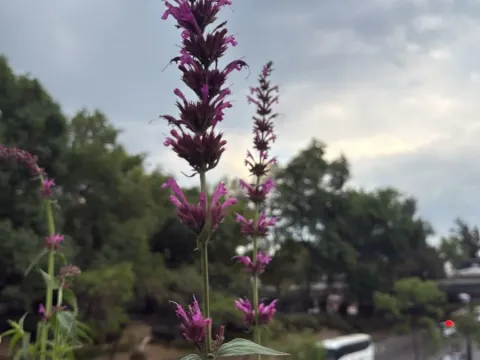
Anise Hyssop
Agastache Clayt. ex Gronov.
Anise Hyssop seeds are tiny and require a well-prepared seedbed for successful germination. Sowing in open ground typically takes place in mid-spring, once the soil has warmed to at least 15°C.
What the section contains
 Agastache cana
 (Hook.) Wooton & Standl.
Agastache cana
Agastache cana (Hook.) Wooton & Standl.
 Agastache cusickii
 (Greenm.) A. Heller
Agastache hybrid
Agastache cana x Agastache pallidiflora
Agastache cusickii
Agastache cusickii (Greenm.) A. Heller
Agastache hybrid
Agastache cana x Agastache pallidiflora
 Agastache hybrid
hybrids between Agastache foeniculum (Pursh) Kuntze and Agastache rugosa (Fisch. & C. A. Mey) Kuntze
Agastache hybrid
hybrids between Agastache foeniculum (Pursh) Kuntze and Agastache rugosa (Fisch. & C. A. Mey) Kuntze
 Agastache pallida
 (Lindl.) Cory var. pallida
Agastache pallida
Agastache pallida (Lindl.) Cory var. pallida
 Agastache pallidiflora
 (A. Heller) Rydb.
Agastache pallidiflora
Agastache pallidiflora (A. Heller) Rydb.
 Agastache rugosa
 (Fisch. & C. A. Mey) Kuntze
Agastache rugosa
Agastache rugosa (Fisch. & C. A. Mey) Kuntze
 Anise hyssop
Agastache foeniculum (Pursh) Kuntze
Anise hyssop
Agastache foeniculum (Pursh) Kuntze
 Mexican giant hyssop
Agastache mexicana (Humb., Bonpl. & Kunth) Linton & Epling
Mexican giant hyssop
Agastache mexicana (Humb., Bonpl. & Kunth) Linton & Epling
 Orange hummingbird mint
Agastache aurantiaca (A.Gray) Lint & Epling
Orange hummingbird mint
Agastache aurantiaca (A.Gray) Lint & Epling
Anise Hyssop
For professional agricultural cultivation, starting seeds in greenhouses during late winter is recommended. This provides a head start on the growing season and ensures stronger seedlings for transplanting.
The seeds should be sown on the soil surface or covered with a very fine layer of soil, as they require some light for optimal germination. Keeping the substrate moist is critical during the first two weeks.
When sowing in fields, a row spacing of 40–50 cm is ideal to allow for proper airflow and weed management. Overcrowding can lead to humidity-related diseases, which the plant is sensitive to.
Once established, plants can be thinned out to maintain a distance of 30 cm between individuals within the row, ensuring each plant has sufficient access to nutrients and space.
Agastache species thrive in sunny locations with well-drained, fertile soil. They belong to the Lamiaceae family and are highly valued for their aromatic foliage and long-lasting spikes of flowers.
The soil pH should ideally range from neutral to slightly alkaline. Heavy clay soils that retain excess moisture should be avoided as they significantly increase the risk of crown and root rot.
While established plants show some drought tolerance, consistent moisture during the vegetative growth phase is necessary to maximize biomass production and oil content.
Fertilization should be balanced. Nitrogen promotes green growth, but excessive amounts can weaken the stem structure and reduce the concentration of essential oils within the leaves.
Anise Hyssop prefers moderate climates. In regions with severe winters, providing a thick layer of mulch can help protect the root system, although some varieties are more cold-hardy than others.
Commercial yields of dried herb mass typically range from 2 to 4 tons per hectare depending on the variety, soil fertility, and the frequency of harvests during a single growing season.
The yield is often higher in the second and third years of the plant's life, as the root system matures and the crown expands, allowing for more vigorous shoot development in early spring.
Essential oil yield is a critical factor for producers in the pharmaceutical and fragrance industries. Harvesting at the peak of flowering ensures the highest possible concentration of volatile compounds.
As a pollinator-friendly plant, Agastache is exceptionally productive for beekeeping. It provides a rich source of nectar throughout the summer, often resulting in high-quality, fragrant honey.
Optimal timing of the harvest is essential to prevent seed production, which redirects the plant's energy away from leaf production and can lead to a premature decline in overall biomass.
Root rot caused by Phytophthora or Pythium species is the most significant threat to Anise Hyssop, especially in fields with poor drainage or during periods of excessive rainfall.
Powdery mildew can affect the foliage during late summer if air circulation is restricted. Using resistant cultivars and maintaining proper plant spacing are the best cultural controls.
Aphids and spider mites are common pests that feed on the soft tissues of the plant. Monitoring should begin as soon as the first warm weather arrives to prevent large-scale infestations.
Slugs and snails can be problematic for young transplants, particularly in wet spring conditions. Providing protective barriers or using organic bait can mitigate this damage.
Crop rotation is vital to prevent the accumulation of soil-borne pathogens. A gap of at least 3–4 years between planting Agastache on the same plot is standard practice.
Harvesting is traditionally done at the beginning of the full bloom phase. Using sharp tools ensures clean cuts, which promotes faster recovery and secondary growth for a later harvest.
The harvested stems should be dried in a dark, shaded environment with constant airflow. Exposure to direct sunlight will cause the degradation of essential oils and loss of the herb's color.
For the production of herbal teas, only the leaves and flower spikes are collected. The stems, if woody, are often removed to ensure a higher quality final product.
Once fully dried, the material should be processed carefully to avoid crushing the aromatic glands, which are located on the underside of the leaves and on the calyx of the flowers.
Storage should be done in airtight containers in a cool, dry place to maintain the potent anise-like fragrance and therapeutic properties of the dried herb for an extended period.