
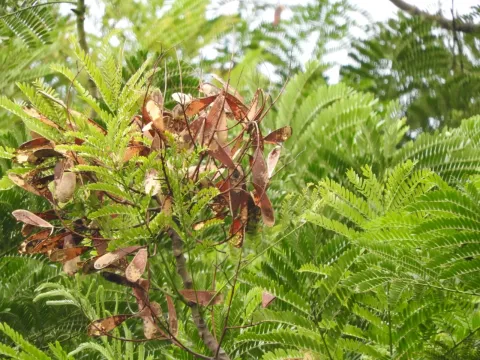
Schizolobium
Schizolobium Vogel
Schizolobium (Schizolobium parahyba) is primarily propagated by seed. To enhance germination rates, seeds require scarification due to their hard coat, which naturally inhibits water absorption.
What the section contains

Schizolobium
In natural and plantation settings, sowing is performed in nurseries at the start of the rainy season to ensure seedlings receive sufficient moisture for proper root establishment.
Once seedlings reach a height of 30–50 cm, they are transplanted to their permanent location in prepared pits. Maintaining proper spacing between trees is crucial as the canopy requires significant room for optimal photosynthesis.
In agroforestry systems, the species is often planted in mixed stands to help prevent soil erosion and facilitate rapid forest cover recovery.
Optimal planting density ranges from 400 to 600 trees per hectare, depending on the management objectives, such as timber production or living fences.
This is a light-demanding species that is highly sensitive to shading, particularly during early growth stages. Trees require direct sunlight for most of the day to ensure healthy development.
Schizolobium thrives in tropical climates with high annual temperatures and no risk of frost, which can be devastating to young, tender shoots.
Soil requirements are moderate; the species prefers deep, well-drained, loamy, or sandy soils with a neutral to slightly acidic pH level.
The tree performs poorly in waterlogged conditions, so selecting a site with proper slope and drainage is essential to avoid excess water accumulation.
Despite its rapid growth, the species is vulnerable to strong winds that can damage the brittle wood of young specimens, necessitating protection from high-velocity gusts.
Schizolobium is recognized as one of the fastest-growing trees in the world. Under favorable conditions, the annual height increase can reach up to 3 meters in the first years.
Significant volumes of commercial timber can be harvested from plantations as early as 10–12 years after planting, making it an economically attractive forest crop.
Maximum productivity is typically observed in regions with abundant and regular rainfall throughout the year, without a pronounced dry season.
The economic value lies in the production of light, soft wood, which is widely utilized in the manufacturing of plywood, matchsticks, and lightweight construction materials.
The total yield also includes biomass, which serves as a valuable resource for high-quality pulp and paper production industries.
The primary threats to plantations include root rot fungi, which often develop due to poor soil drainage or excessive moisture levels in the root zone.
Pests, such as stem borers and various leaf-feeding insects, can cause significant damage to young trees, especially in mono-cultural plantation setups.
Strong storm winds represent a critical risk, often causing windthrow and stem snapping due to the specific architectural structure of the Schizolobium canopy.
During the establishment phase, plantations are prone to weed competition, which inhibits nutrient and moisture uptake, requiring consistent weed management.
Disease prevention strategies include maintaining nursery hygiene, inspecting planting stock for quality, and implementing integrated biological control methods.
Technical maturity of the wood is reached relatively quickly, allowing for selective or clear-cutting operations at relatively short time intervals.
Harvesting is performed by felling the trunks and removing branches directly at the logging site to facilitate easier transport to processing facilities.
Freshly harvested timber requires immediate primary processing or drying, as high moisture content makes the wood susceptible to rapid decay and mold growth.
After harvest, plantations are typically replenished through new plantings, as this species does not always exhibit strong coppicing ability.
Modern logging techniques allow for minimized wood waste and increased processing efficiency, ensuring the maximum value is extracted from the harvested timber.