
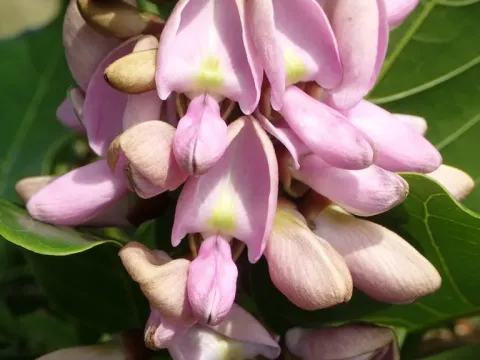
Millettia
Millettia Wight & Arn.
Millettia (Millettia) is a diverse genus of tropical trees, shrubs, and woody climbers belonging to the Fabaceae family. Native to Africa, Asia, and Australia, these plants are highly valued in both their natural ecosystems and various agricultural applications.
What the section contains

Millettia
The crop thrives in tropical and subtropical climates where temperatures remain consistently high throughout the year. It does not tolerate frost and requires a frost-free growing environment to achieve its maximum potential.
Regarding soil requirements, Millettia species prefer deep, well-draining soils with a neutral or slightly acidic pH. While they can grow in various soil types, poor drainage can lead to root system decay, which is the primary limitation for large-scale production.
Agricultural management requires careful attention to irrigation, especially during the establishment phase. Ensuring adequate soil moisture without causing waterlogging is crucial for developing a robust root structure that can support rapid aerial growth.
Economically, Millettia is significant for its high-quality, durable timber and its potential as a natural insecticide. Certain species produce secondary metabolites such as rotenone, which are extensively researched for organic pest control applications.
The primary threats to Millettia cultivation include various fungal diseases, most notably root rot triggered by poor soil aeration and water accumulation. These pathogens can rapidly decimate young plantations if irrigation management is not strictly controlled.
Leaf-feeding insects, such as beetles and lepidopteran larvae, represent a major threat to the photosynthetic capacity of the plants. Continuous monitoring is required to detect early signs of infestation before significant foliage loss occurs.
Fungal leaf spots can also occur in high-humidity environments where canopy density prevents effective airflow. Improving spacing and implementing light pruning strategies are essential to keep the plantations healthy and productive.
Pest management programs for this crop often emphasize integrated pest management (IPM) techniques, including the use of beneficial predators and mechanical removal, to ensure long-term viability and ecological stability of the farm.
Furthermore, maintaining soil fertility through balanced nutrient management is vital. Micronutrient deficiencies can weaken the plant, making it significantly more susceptible to opportunistic pathogens and environmental stressors.