
Inga
Inga
Inga is a genus of evergreen trees belonging to the Fabaceae family, originating from the tropical regions of the Americas. These trees are widely recognized for their long, pod-like fruits containing a sweet, cotton-candy-like pulp.
What the section contains

Inga
The seeds of Inga are recalcitrant, meaning they have a short lifespan and lose viability quickly after being extracted from the pod. Therefore, immediate planting into a nutrient-rich, moist medium is required for successful germination.
Nursery propagation is standard, with seeds sown in individual containers to prevent root disturbance. Providing a warm, humid environment ensures that the seedlings emerge and develop their first true leaves within a few weeks.
Transplanting to the field should occur when the saplings have reached a height of about 30–50 centimeters. It is crucial to maintain adequate spacing, as many Inga species develop broad, spreading canopies that require significant space.
Vegetative propagation via cuttings is possible but more demanding than seed sowing. Success depends on maintaining high humidity and stable temperatures, often requiring specialized misting systems in professional nursery settings.
Inga thrives in humid tropical climates where temperatures remain consistently between 20 and 30 degrees Celsius. The plant has zero frost tolerance and can be severely damaged by even short-lived cold snaps.
The tree prefers deep, fertile, and well-drained soils. One of its most valuable traits is its ability to fix nitrogen from the atmosphere through a symbiotic relationship with bacteria in its root nodules, which naturally fertilizes the soil.
Regular rainfall is ideal for the growth of Inga, although established trees can handle short dry periods. In plantations, ensuring consistent moisture levels is vital for fruit development and foliage health.
Light requirements depend on the tree's maturity. While young saplings benefit from partial shade, mature trees require full sunlight to produce the energy necessary for heavy fruiting and robust growth.
Agrotechnical maintenance includes regular pruning, which is not only essential for shaping the tree but also for keeping the canopy open. Proper ventilation reduces the risk of moisture-related fungal issues within the dense foliage.
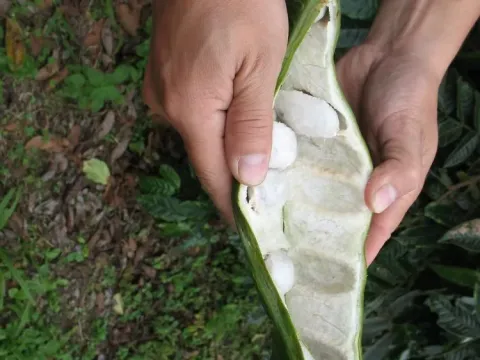
The fruit of Inga consists of large, elongated pods containing seeds embedded in a sweet, white, succulent pulp. This pulp is highly prized as a refreshing tropical snack, often referred to as the ice cream bean.
Inga trees grow quickly and usually begin to yield their first fruits within 2 to 4 years of planting. Under favorable conditions, the trees can produce multiple harvests throughout the year, contributing to high annual yields.
Harvesting is performed by manually picking the mature pods from the branches. It is essential to harvest at the right time, as pods left too long on the tree may burst or begin to dry out, reducing their quality.
Beyond human consumption, the tree is a staple in agroforestry. It is frequently planted as a shade tree for coffee and cacao crops, where its nitrogen-fixing roots and leaf mulch significantly improve crop yields and soil health.
The potential for economic gain includes both the direct sale of fruit and the indirect benefits of higher yields in adjacent crops due to the improved soil environment created by the Inga trees.
Root rot, often caused by pathogens like Phytophthora, is a primary threat, particularly in soils with poor drainage. Once established, these infections are difficult to treat and can result in the loss of entire trees.
Pests such as various lepidopteran caterpillars can cause significant defoliation if left unchecked. Additionally, certain types of borers may target the pods, rendering the fruit unsuitable for human consumption.
Fungal leaf spots are common in areas with high humidity and poor airflow. Managing the density of the plantation and conducting regular pruning are the most effective ways to mitigate the spread of these pathogens.
Integrated pest management is recommended to maintain the health of the orchard. This includes monitoring for early signs of infestation and encouraging natural predators to control insect populations without relying on heavy chemical use.
Sanitation practices are essential for disease prevention. Removing and destroying infected plant material promptly prevents the build-up of inoculum, ensuring the long-term productivity and health of the Inga plantation.