
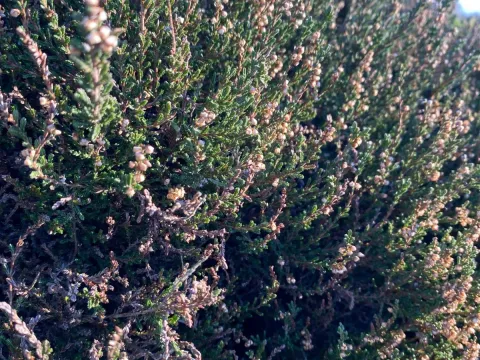
Common heather
Calluna Salisb.
Common heather (Calluna vulgaris) is a perennial, low-growing evergreen shrub belonging to the Ericaceae family. It is a robust plant native to Europe and Asia Minor, adapted to survive in harsh, nutrient-poor landscapes.
What the section contains

Common heather
To cultivate heather successfully, it is essential to provide acidic soil with a pH range between 3.5 and 5.5. Soil lime content is detrimental, so growers must avoid adding alkaline components and ensure the medium is rich in organic peat.
The plant thrives in full sun but tolerates partial shade. Sufficient light is crucial for the development of its distinctive foliage color and to ensure a dense, compact growth habit rather than an elongated, weak structure.
Heather requires well-draining soil to prevent root rot. In areas with heavy clay or poor drainage, creating raised beds with a mix of sand, peat, and organic matter is a standard agricultural practice to ensure longevity.
Maintaining heather involves annual pruning immediately after flowering or in early spring. This practice promotes vigorous new growth, increases the number of flower spikes for the following season, and keeps the plants from becoming too woody.
Heather is highly regarded in the beekeeping industry as a vital late-season nectar source. Honey produced from heather is distinctive for its thixotropic properties—it is jelly-like in the comb and requires mechanical extraction.
The floral yield is highly dependent on humidity levels and late-summer temperatures. In ideal conditions, large heather moors can support high densities of honeybees, providing a critical late-season boost to colony populations.
Botanically, heather shoots and flowers are used in pharmacology due to their high content of tannins, arbutin, and flavonoids. These compounds offer natural antimicrobial and diuretic properties, often utilized in herbal medicine.
In landscaping, heather is used extensively for its aesthetic value, particularly in "heather gardens." Its ability to cover large areas of infertile, rocky ground makes it an excellent choice for erosion control in agricultural projects.
Historical use includes the production of brushes, brooms, and thatching material. While modern substitutes have replaced these, organic farming continues to value heather for its role in maintaining biodiversity in rural ecosystems.
Phytophthora root rot is the most serious disease affecting heather, typically triggered by waterlogged soil conditions. Once established, the fungus can quickly kill sections or entire plants if drainage is not corrected.
Pests such as spider mites and scale insects can attack the plant during hot, dry summer spells. Using targeted systemic insecticides is necessary to control populations and protect the plant's evergreen foliage.
Iron chlorosis is a common physiological problem caused by an excessively high soil pH. If the soil becomes too alkaline, the plant cannot absorb sufficient nutrients, causing leaves to yellow while veins remain green.
Powdery mildew may occur in poorly ventilated areas where plants are spaced too closely. Ensuring proper airflow through regular pruning and strategic planting can effectively mitigate this risk without heavy fungicide use.
Viral infections can cause stunted growth and deformed flowers. Since there is no cure, infected plants must be removed and destroyed to prevent the spread of the virus to healthy parts of the crop plantation.