
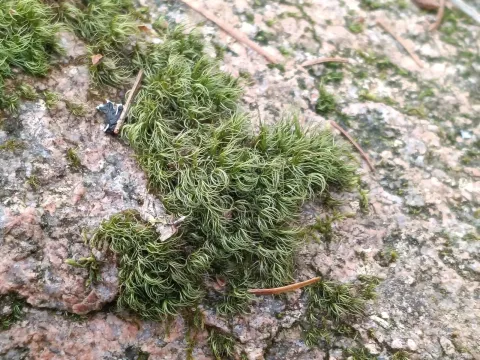
Paraleucobryum longifolium
Paraleucobryum longifolium
Paraleucobryum longifolium is a perennial moss species belonging to the Dicranaceae family. It is widely recognized for its preference for temperate forest environments where moisture levels are consistently high throughout the year.
What the section contains
Paraleucobryum longifolium
The plant grows predominantly on tree bases, decaying logs, and moist rocky substrates. Its ecological niche is defined by its ability to thrive in shaded environments where direct sunlight is filtered by the canopy.
Botanically, the species is identified by its long, linear-lanceolate leaves that are distinctively channelled. These leaves form dense, often glaucous-green cushions that provide a soft texture to the forest floor.
Environmental requirements include a stable, humid climate and well-drained acidic substrates. The species lacks a cuticle, making it highly susceptible to dehydration, which limits its growth to protected micro-habitats.
Economically and ecologically, it serves as a critical component in forest moisture retention and erosion control. While not a conventional crop, its unique morphology makes it a subject of interest in specialized botanical nurseries and ecological restoration projects.
The primary threats to this species include large-scale deforestation and the destruction of old-growth forest micro-habitats essential for its development.
Air pollution acts as a significant limiting factor, as the species relies on atmospheric moisture and is highly sensitive to chemical contaminants.
Fragmented forest landscapes disrupt the spore dispersal process, leading to the isolation of small, vulnerable populations of the moss.
Over-collection in certain areas for landscaping or scientific study can also diminish local population density if not properly managed.
Desiccation caused by the opening of the forest canopy can result in the rapid death of entire colonies, as they cannot cope with increased solar exposure.