
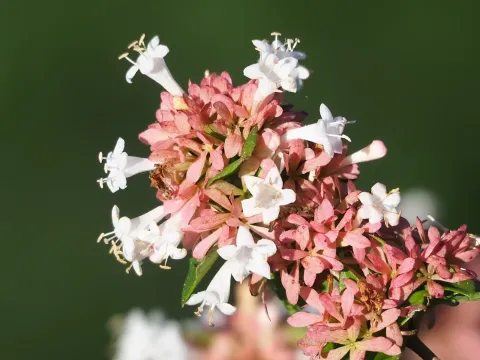
Abelia
Abelia R. Br.
Abelia is a genus of deciduous and evergreen shrubs belonging to the Caprifoliaceae family. These plants are native to Eastern Asia, the Himalayas, and parts of Mexico, where they thrive in warm, temperate climates with adequate moisture.
What the section contains
 Abelia engleriana
 (Graebn.) Rehder
Abelia engleriana
Abelia engleriana (Graebn.) Rehder
 Abelia floribunda
 (M. Martens & Galeotti) Decne.
Abelia floribunda
Abelia floribunda (M. Martens & Galeotti) Decne.
 Chinese abelia
Abelia chinensis R. Br.
Chinese abelia
Abelia chinensis R. Br.
 Glossy Abelia
Abelia xgrandiflora x Abelia parvifolia
Glossy Abelia
Abelia x grandiflora Rehder
Glossy Abelia
Abelia xgrandiflora x Abelia parvifolia
Glossy Abelia
Abelia x grandiflora Rehder
 Korean abelia
Abelia mosanensis I. C. Chung ex Nakai
Korean abelia
Abelia mosanensis I. C. Chung ex Nakai
 Small-leaf abelia
Abelia parvifolia Hemsl.
Small-leaf abelia
Abelia parvifolia Hemsl.
 Three-flowered abelia
Abelia triflora R. Br.
Three-flowered abelia
Abelia triflora R. Br.
Abelia
For successful cultivation, Abelia requires a spot with full sun or partial shade, protected from harsh, drying winds. The soil should be fertile, well-draining, and slightly acidic, ensuring the root system does not suffer from waterlogging.
The plant is not fully frost-hardy, making it suitable for outdoor planting primarily in mild climates. In regions with freezing winters, it is standard practice to use pots for easier movement into sheltered areas during the dormant season.
Regular maintenance includes consistent watering during the growing season and periodic fertilization with balanced nutrients to support flowering. It is essential to monitor soil moisture levels, as Abelia does not tolerate drought or excessive saturation.
Pruning is a vital horticultural practice for Abelia. It should be performed after the main flowering season to shape the plant and remove dead wood, which promotes better air circulation and subsequent growth in the following year.
Common pests that infest Abelia include aphids and spider mites, particularly in greenhouses or under dry conditions. Regular monitoring of the foliage and timely application of insecticidal soaps or specific acaricides are recommended to control infestations.
Diseases affecting Abelia are primarily associated with improper environmental conditions, such as poor drainage leading to root rot. Additionally, powdery mildew may appear if the plant is grown in areas with poor airflow or high humidity combined with limited sunlight.