
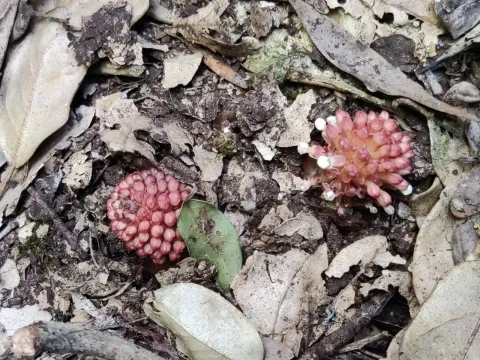
Balanophora
Balanophora
Balanophora is a genus of obligate root parasitic plants belonging to the family Balanophoraceae. These plants are entirely devoid of chlorophyll, meaning they are incapable of photosynthesis and must derive all necessary nutrients directly from the roots of their host plants.
What the section contains


Balanophora
The genus is primarily distributed throughout tropical and subtropical regions in Asia, Africa, Madagascar, and various Pacific islands. They favor humid forest environments with dense canopies, where shade and high soil moisture provide the optimal conditions for their survival.
Biologically, the plant consists of an underground tuberous rhizome that deeply penetrates the host tree's root tissues, and a flowering stalk that emerges above the soil surface. Their fleshy, brightly colored reproductive organs often mimic the appearance of fungi, which historically confused early botanists.
These plants have highly specific ecological requirements: they rely exclusively on a continuous supply of metabolites from the host tree. Without direct contact with the root system of a suitable donor plant, Balanophora cannot survive or successfully develop from its seeds.
There is no agricultural use for this genus, as it is not an agricultural crop. Conversely, in some regions, it may be viewed as a biological agent that can weaken forest stands, although it typically does not cause significant economic damage in a commercial sense.