
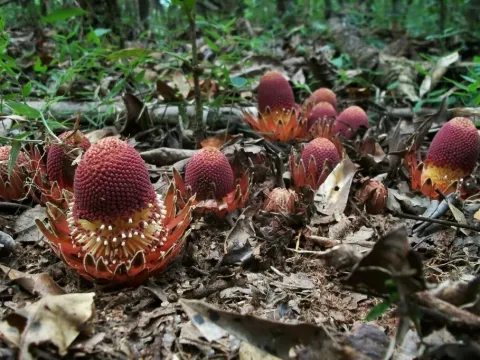
Langsdorffia
Langsdorffia
Langsdorffia belongs to the Balanophoraceae family and is recognized as a holoparasitic plant. Because it lacks chlorophyll, it is entirely incapable of photosynthesis and must extract nutrients directly from the host plant's root system.
What the section contains

Langsdorffia
The plant grows predominantly underground, surfacing only to produce fleshy, mushroom-like inflorescences for reproduction. Its ecological survival depends strictly on the presence of specific tropical tree species that act as hosts.
Native to the tropical regions of Central and South America, as well as parts of Africa and the Pacific islands, Langsdorffia requires a high-humidity environment and stable forest floor conditions to thrive.
Due to its specialized parasitic lifestyle, Langsdorffia cannot be cultivated using conventional agricultural techniques. It lacks commercial utility in farming as it requires a fully established tree host to complete its lifecycle.
Agricultural research does not currently include Langsdorffia in crop production manuals because its growth patterns are inseparable from wild forest ecosystems. It remains a fascinating subject for botanical research rather than human-managed agriculture.