
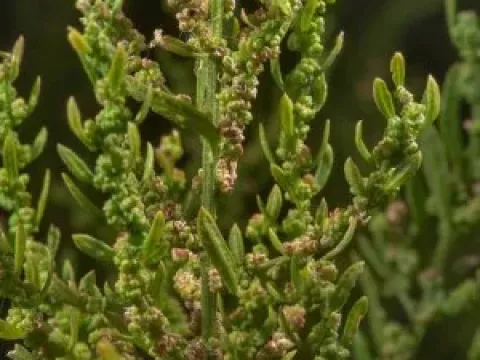
Chenopodium integrifolium
Chenopodium integrifolium
Sowing of Chenopodium integrifolium is carried out in spring once the soil temperature reaches 10–12°C. The seeds are placed at a depth of no more than 1–2 centimeters, accounting for their small size and requiring a firm contact between the seed and the moist substrate.
What the section contains
Chenopodium integrifolium
The crop is characterized by high germination energy, allowing for uniform emergence under stable moisture conditions. The optimal plant density depends on the purpose of cultivation—whether for greens or seed—averaging between 200,000 and 400,000 plants per hectare.
In regions with short growing seasons, transplanting from seedlings may be used to accelerate the development cycle. However, direct seeding remains the preferred method for commercial production as it allows plants to establish a more robust root system.
To prevent weed competition during the early stages, strict control over the seedbed is necessary. Once the true leaves are formed, the plant grows rapidly and effectively suppresses surrounding vegetation.
Sowing dates must be adjusted based on regional climatic conditions, avoiding late frosts that can damage young seedlings. Careful planning ensures that the plant avoids thermal stress during the most sensitive early stages.
Chenopodium integrifolium belongs to the Amaranthaceae family and displays resilience to moderately arid conditions. It prefers well-drained, fertile sandy or loamy soils with a neutral or slightly alkaline pH level.
The crop is highly light-demanding and does not tolerate shading, therefore, open fields are selected for planting. Lack of solar radiation leads to stem elongation and a significant decrease in overall biomass productivity.
The optimal temperature for active growth is 20–25°C. The plant is adaptable to temperature fluctuations, making it a promising option for cultivation in various climatic zones, including temperate latitudes.
Special requirements apply to nitrogen nutrition during the first half of the vegetative period, which is critical for biomass accumulation. However, excess fertilizer can lead to stem lodging, so the use of balanced mineral complexes is recommended.
Irrigation should be moderate: Chenopodium integrifolium poorly tolerates waterlogging, which can provoke root rot. Drip irrigation is highly effective as it maintains a stable water regime in the root zone.
The yield of green biomass reaches high levels under intensive cultivation technology. On average, one hectare can produce 15 to 25 tons of fresh biomass suitable for food industry processing or fodder purposes.
When cultivated for seeds, productivity ranges from 1.5 to 3 tons per hectare depending on soil fertility. The seeds are noted for their high nutritional value and protein content, making the crop highly sought after in the health food market.
Yields are directly dependent on the timeliness of agronomic practices such as thinning and fertilizing. The absence of stress factors during the flowering phase allows the plant to fully realize its genetic potential.
An important factor is maintaining uniform maturation of the inflorescences, which prevents grain loss during harvest. Breeding efforts are focused on increasing resistance to pod shattering and improving seed quality.
Yield indicators remain stable even in years with rainfall deficits, which confirms the high adaptability of Chenopodium integrifolium to changing climatic conditions.
The greatest threat to the crop comes from leaf-eating insect pests, particularly various species of flea beetles. These can damage young seedlings, causing significant loss of the stand during the early growth phase.
In conditions of high humidity and dense planting, fungal diseases such as powdery mildew or downy mildew may develop. These manifest as surface coatings on the leaves, reducing the marketability of the product and slowing down photosynthesis.
Preventive measures for crop protection include crop rotation and spatial isolation from other members of the Amaranthaceae family. This helps reduce the infection pressure and prevents the spread of viral diseases by insect vectors.
- Regular phytosanitary monitoring of plantations.
- Use of high-quality treated seed material.
- Timely weed removal to eliminate pest reservoirs.
- Application of insecticides during periods of peak pest infestation.
- Adherence to seeding rates to ensure sufficient ventilation.
Disease management requires a systemic approach where chemical protection methods are integrated with agronomic techniques to minimize pesticide load on the harvest.
Harvesting for greens is conducted before the onset of massive flowering, when the leaves reach their maximum size and contain the highest concentration of nutrients. Mechanized harvesting is performed using specialized mowers followed by rapid transport.
When harvesting for seeds, it is important to wait for full maturation of the panicles, when the seeds acquire their characteristic color and are easily separated during threshing. Harvesting should be performed in dry weather to avoid moisture issues in the grain.
After collection, the seed material undergoes mandatory cleaning to remove impurities and drying to a moisture content of no more than 12-14%. This ensures the preservation of nutritional qualities and prevents mold development in storage.
Modern combines minimize grain loss thanks to the adjustment of threshing mechanisms specifically for small-seeded crops. Setting the gaps and drum speed is critical to preventing damage to the seed coat.
A well-organized harvest process significantly increases the economic efficiency of production and ensures the high quality of either the grain or green product.