
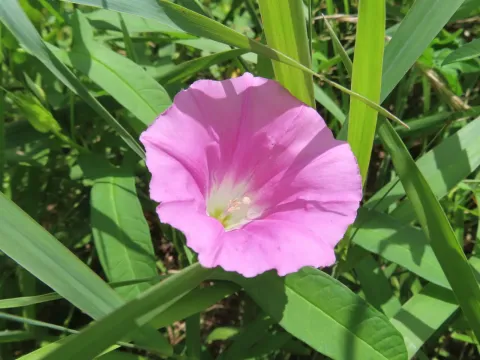
Japanese false bindweed
Calystegia japonica
Japanese false bindweed (Calystegia japonica) is a robust perennial plant belonging to the Convolvulaceae family. Native to East Asia, including Japan, Korea, and China, it is well-known for its invasive nature due to its spreading rhizomatous root system. In many regions, it is treated as a challenging weed, but it also possesses qualities suitable for specific landscape applications.
What the section contains
Japanese false bindweed
The plant features twining stems that can climb several meters high, clinging to various supports. Its leaves are triangular to arrow-shaped, creating dense foliage. The most distinguishing feature is its trumpet-shaped, delicate flowers, which add aesthetic value during the mid-to-late summer season.
Regarding environmental needs, the plant thrives in full sun but can tolerate partial shade. It prefers moist, fertile, and well-drained soils, though it shows remarkable adaptability to various soil types, including clays. It is hardy in a wide range of temperate climates, showing significant resilience to drought once established.
Cultivation requires strict management of the root system. If grown ornamentally, it is crucial to use containment methods, such as deep root barriers or large containers, to prevent it from outcompeting other garden vegetation. Minimal maintenance is required, though occasional pruning helps to shape the plant and encourage denser growth.
In terms of хозяйственного usage, Japanese false bindweed is primarily utilized for quick vertical screening and erosion control on slopes. Its rapid growth rate makes it an excellent choice for covering bare ground or unsightly structures where low-maintenance coverage is desired. Some medicinal traditions also suggest limited use of the roots, though this is not a mainstream agricultural application.
Common pests include aphids that feed on tender stem tips and various beetles that skeletonize the foliage. While generally resistant, the plant can be susceptible to fungal infections like powdery mildew under conditions of high humidity and poor air circulation. Regular monitoring and, if necessary, localized treatment are effective control strategies.