
Fraser fir
Abies fraseri (Pursh) Poir.
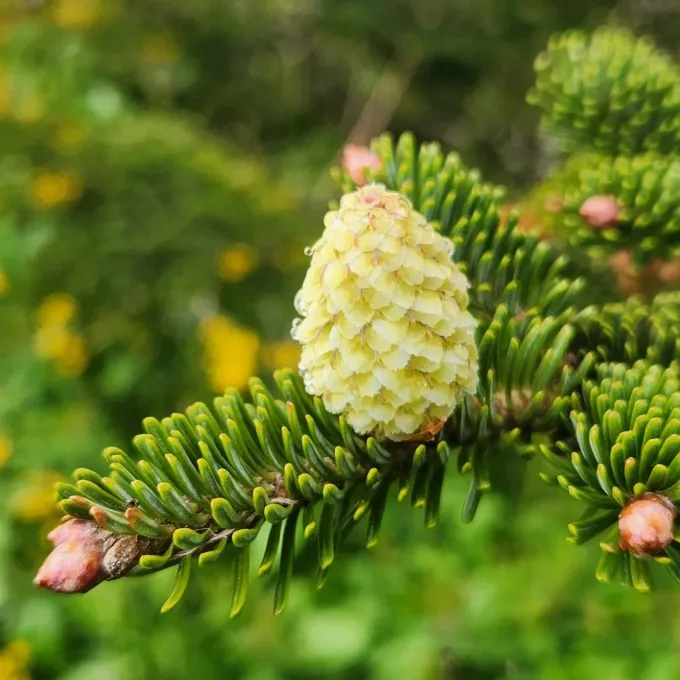
Description
Sowing dates
The reproduction of Fraser fir is primarily achieved through seeds, which require a mandatory stratification process at temperatures between 1 and 5 degrees Celsius for approximately two months to break dormancy.
Sowing in nurseries typically takes place in early spring after the frost threat has passed. Seeds should be planted at a shallow depth of about 1 to 1.5 centimeters in a well-prepared, moist potting medium.
Young seedlings are extremely sensitive to intense sunlight and drought during their first few years. Providing artificial shade is essential for ensuring successful establishment and preventing seedling mortality.
Vegetative propagation via cuttings is technically demanding and often results in lower success rates than seed propagation. Success requires high humidity and the application of rooting hormones to stimulate development.
Transplanting seedlings to their final location is best performed in early spring or autumn when transpiration rates are lower, facilitating better root establishment before the extreme temperatures of summer or winter.
Growing requirements
Fraser fir (Abies fraseri) is a member of the Pinaceae family, native to the high-elevation zones of the Appalachian Mountains. It thrives in cool, moist climates and is sensitive to heat stress and humidity extremes.
The ideal soil conditions include deep, well-drained loams or sandy loams with an acidic reaction (pH 5.0 to 6.0). Poor drainage is fatal to this species, as it rapidly leads to root rot and tree decline.
This species exhibits significant cold hardiness but requires a stable microclimate to perform at its peak. While it can handle light shade, full exposure to cool, clean mountain air provides the best results.
Adequate soil moisture must be maintained throughout the growing season. In commercial plantations, irrigation systems are frequently employed to supplement rainfall during the dry summer months to ensure vigorous growth.
Protection from industrial pollutants and excessive dust is crucial, as the Fraser fir is sensitive to atmospheric quality, which can adversely affect its foliage density and overall health.
Main diseases and pests
The balsam woolly adelgid represents the most significant biological threat to Fraser fir, as it infests the bark and stunts the tree's development, often leading to mortality if left untreated.
Root rots, particularly those caused by Phytophthora species, occur frequently in poorly drained soils. These pathogens can wipe out entire plantation blocks if water management is neglected.
Needle cast diseases, which lead to premature defoliation, are common in humid environments. Regular monitoring and targeted fungicide applications are necessary to preserve the tree's ornamental quality.
Insect pests like spruce budworms and various types of loopers can cause severe damage to new growth. Integrated pest management strategies are recommended to minimize chemical usage while maintaining tree health.
Sanitation practices, such as the removal of diseased or dead wood, are vital in preventing the spread of fungal pathogens throughout the plantation area.
Harvesting
The primary economic use of Fraser fir is the production of premium Christmas trees, valued for their excellent needle retention, pleasant fragrance, and classic pyramid-like symmetry.
Commercial harvesting usually begins when trees reach a marketable height, typically after 7 to 10 years of meticulous cultivation, which includes annual shearing to promote dense, uniform branching.
Harvesting is performed in late autumn as trees reach dormancy, ensuring that the moisture content is retained, which is critical for long-lasting freshness in a indoor setting.
After being cut, trees must be stored in cool, shaded environments to prevent rapid moisture loss. Proper logistics and transportation are required to deliver the trees in pristine condition.
Grading is a essential part of the post-harvest process, where trees are sorted based on height, shape, and foliage density to meet strict market standards for quality and presentation.