
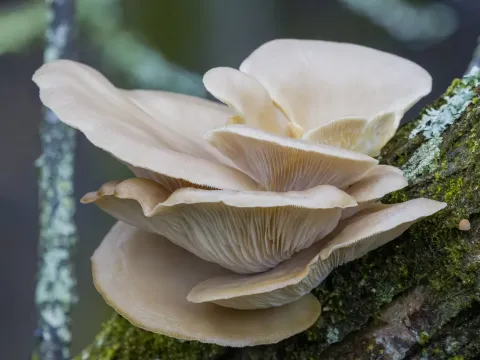
Oyster mushroom
Pleurotus ostreatus (Jacq.) P. Kumm.
Oyster mushroom (Pleurotus ostreatus) is a highly adaptable wood-decay fungus belonging to the Pleurotaceae family. Commercial cultivation is conducted year-round, as the crop does not depend on seasonal weather if climate-controlled environments are provided.
What the section contains
Oyster mushroom
The substrate preparation involves using agricultural waste such as wheat straw, sunflower seed hulls, or hardwood sawdust. The material must be pasteurized or sterilized to eliminate competing molds and bacteria before inoculation.
Once the substrate cools down to 20–25 °C, it is inoculated with grain-based spawn. The typical inoculation rate ranges from 2% to 5% by weight of the damp substrate material.
The inoculated substrate is packed into specialized bags or blocks and moved to an incubation room. The incubation period takes 14 to 21 days, during which the mycelium completely colonizes the medium.
Total darkness or dim light is maintained during incubation to ensure even growth of the mycelium throughout the entire substrate block before the initiation of fruiting stages.
Successful vegetative growth requires a stable temperature range of 20–24 °C. Temperatures exceeding 30 °C can cause the mycelium to overheat and perish, leading to complete crop failure.
During the fruiting phase, conditions shift significantly; the ideal temperature is 12–16 °C. Relative humidity must be maintained at a high level, specifically between 85% and 90%.
Lighting is a critical factor for fruit body development. Without adequate light, the mushrooms become etiolated, with long stems and poorly developed, deformed caps, which significantly reduces their commercial value.
Proper ventilation is essential to manage CO2 levels. Excessively high carbon dioxide levels in the growing chamber will cause abnormal growth and inhibit the formation of healthy clusters.
Maintaining a high standard of hygiene is paramount. Regular air exchange and surface disinfection are required to prevent the buildup of pathogens and spores within the growing environment.
The biological efficiency of Pleurotus ostreatus typically ranges from 20% to 35% of the wet substrate weight. With high-performance strains and optimized environments, yields can reach up to 40%.
The harvest is achieved in several flushes. The first flush is usually the most productive, accounting for the majority of the total yield from a single substrate block.
A second flush typically appears 10–14 days after the first one is harvested. While lower in volume, it remains economically important for overall profitability.
While third flushes are possible, they are often considered inefficient for large-scale operations due to the energy costs associated with maintaining the environment compared to the lower yield.
Selecting reliable, high-yield strains and maintaining optimal water content in the substrate are the primary levers for increasing overall farm output and product quality.
Green mold (Trichoderma) is the most destructive disease. It thrives in improperly sterilized substrates and can rapidly colonize and kill off the mushroom mycelium.
Bacterial blotch appears as yellowish or brown spots on the mushroom caps, usually caused by poor air circulation and excessive moisture on the fruit bodies, leading to rapid tissue degradation.
Pests like sciarid flies and mushroom gnats are major concerns. Their larvae bore into the caps and mycelium, causing physical damage and spreading fungal spores that invite secondary infections.
Mites can also cause significant damage by feeding on the mycelium, effectively stalling growth and preventing the development of fruit bodies even when climate conditions are perfect.
Integrated pest management includes strict sanitation, the use of fine-mesh filters on vents to block insect access, and the immediate removal of any infected or damaged blocks.
Mushrooms should be harvested when the edges of the caps are still flat or slightly curled downward. Harvesting at the correct stage prevents excessive spore shedding and maintains freshness.
The clusters are either cut or carefully twisted off the substrate block. It is essential to remove all stem remnants to prevent them from rotting and attracting pests.
Post-harvest, the mushrooms should be cooled immediately to 0–2 °C. Proper cold chain management ensures the product maintains shelf life for up to one week.
The harvested produce is sorted by size and physical condition. Deformed or broken caps are separated from high-quality clusters to meet market standards for retail packaging.
Careful handling during the packing process is required to avoid bruising, as the fruit bodies are delicate and prone to physical damage which accelerates quality loss.