
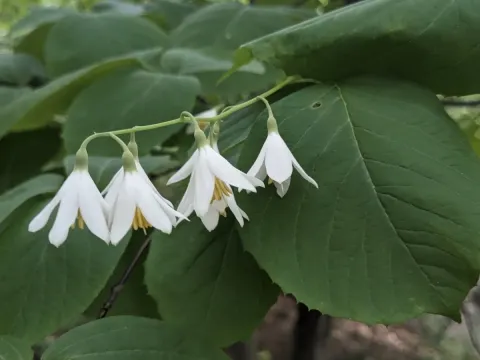
Fragrant snowbell
Styrax obassia
The Fragrant snowbell (Styrax obassia) is a distinguished member of the Styracaceae family, valued for its large, heart-shaped leaves and pendent, bell-shaped white flowers. This deciduous tree can reach significant heights, making it an excellent specimen for larger garden spaces.
What the section contains
Fragrant snowbell
Native to the woodlands of Japan, China, and Korea, this species thrives in environments that offer dappled sunlight and protection from harsh afternoon heat. Providing a site with wind shelter is essential to preserve the delicate foliage during the growing season.
Regarding soil, the Fragrant snowbell requires well-draining, moisture-retentive, and humus-rich loam. It is sensitive to alkaline conditions, which often lead to iron chlorosis, manifesting as yellowing between the leaf veins and stunted overall growth.
Cultural maintenance involves maintaining consistent soil moisture, especially during the tree's formative years. Applying a layer of organic mulch around the root zone helps regulate soil temperature and retains humidity, mimicking the natural forest floor conditions.
Propagation is primarily achieved via seed sowing. Due to dormancy, the seeds require a cold stratification period of several months, which is best initiated in the autumn to allow for natural exposure to winter temperatures before spring germination.
While generally robust, the Fragrant snowbell can be susceptible to soil-borne pathogens like Phytophthora if drainage is compromised, necessitating careful site selection.
Foliar pests, such as aphids or spider mites, can occasionally become problematic during prolonged periods of drought, which weaken the plant's natural defense mechanisms.
Mechanical damage from severe winter frost or ice accumulation can cause branch breakage, which requires prompt pruning to prevent entry points for wood-decay fungi.
Regular monitoring for leaf spots caused by fungal pathogens is recommended, especially in regions with high humidity during the mid-summer months.
To ensure long-term health, avoid deep cultivation around the base of the tree to prevent damaging the fine, fibrous root system that lies close to the surface.