
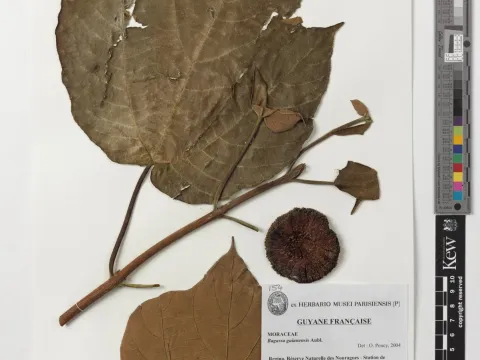
Bagassa
Bagassa
Bagassa (Bagassa guianensis) is a majestic tropical tree species belonging to the Moraceae family. Often referred to as the 'Yara' or 'Cavi' tree, it is a significant element of the South American tropical rainforest canopy.
What the section contains

Bagassa
Native to the Amazon basin, the tree thrives in the humid, tropical climates of Brazil, Guyana, Suriname, and French Guiana. It is typically found in primary forests with high annual rainfall and constant temperatures.
The species requires nutrient-rich, deep, and well-drained alluvial soils to achieve its full potential. It is sensitive to soil compaction and waterlogging, which can impede the development of its root system.
Botanically, Bagassa is characterized by its large, spreading crown and robust trunk, which can grow to impressive heights. It exhibits a high demand for light as it matures, often rising above the forest floor to capture canopy sunlight.
The tree's ecological role is vital, as it provides shelter and resources for various tropical fauna, including birds and insects. Managing its natural habitat is crucial for maintaining forest biodiversity in the Amazonian region.
Harvesting of Bagassa is primarily conducted through selective logging practices. Given the slow growth rate of the tree, sustainable management is strictly enforced to ensure the survival of the species in the wild.
The timber is highly valued in the global market for its excellent durability and resistance to decay, termites, and other pests. These properties make it a premier choice for outdoor construction and heavy-duty furniture.
Once harvested, the logs undergo milling and seasoning. The heartwood is particularly prized for its yellowish-brown to golden-brown color, which develops a rich patina over time.
Technological processing of Bagassa wood requires specialized equipment due to its high density and hardness. Proper kiln drying is essential to prevent warping and to enhance the stability of the finished wood products.
Global demand for exotic, sustainable hardwoods encourages ongoing research into artificial propagation methods, aiming to introduce Bagassa into plantation forestry to reduce pressure on natural forest reserves.