
Spanish moss
Tillandsia usneoides (L.) L.
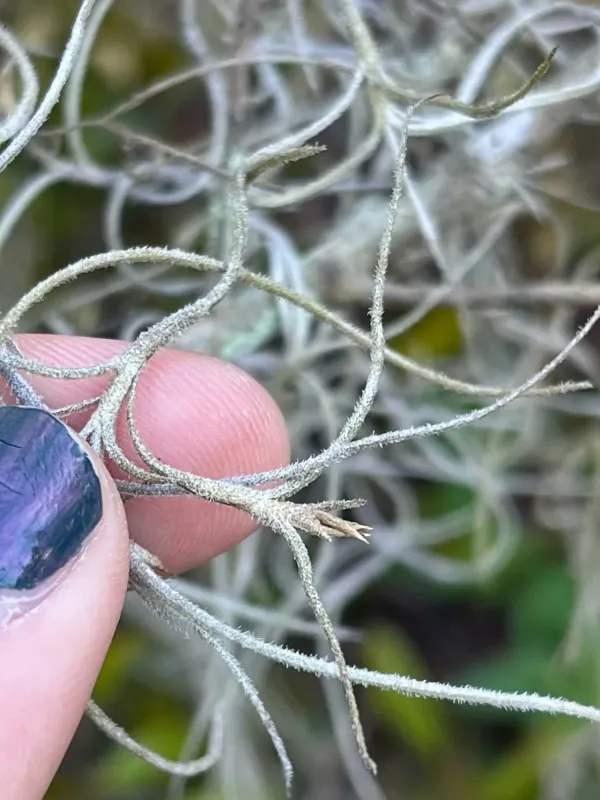
Description
Growing requirements
Spanish moss (Tillandsia usneoides) is a fascinating epiphytic flowering plant belonging to the Bromeliaceae family. Despite its common name, it is not a moss, but a perennial plant that derives its name from its similarity to Usnea lichen and its characteristic pendulous growth habit.
Native to the Americas, ranging from the southeastern United States to Argentina, it thrives in warm, humid climates. It lives in trees but is not parasitic, as it absorbs all necessary water and nutrients directly from the atmosphere through specialized leaf scales called trichomes.
Cultivation requires bright, indirect light to prevent leaf scorch. The ideal temperature range is between 18°C and 26°C. Excellent air circulation is essential for the plant's health, as it helps prevent moisture from lingering too long and causing rot in the dense clusters.
This species requires no soil or planting medium. It is best grown by suspending the clumps on decorative supports, such as driftwood, wire frames, or bark. The key is to ensure the plant can hang freely, mimicking its natural state of attachment to branches.
Agrotechnical care focuses on consistent misting with distilled or soft water. The plant should be allowed to dry completely between waterings, as constant saturation is detrimental. During dry, hot periods, more frequent moisture application may be necessary to support vitality.
Yield
Historically, Spanish moss has been harvested and processed for industrial use as a stuffing material for upholstery, mattresses, and insulation. Its resilience and natural resistance to decay made it a valuable raw material in the early 20th century.
In contemporary settings, the "yield" refers to its ornamental value. It is widely used in landscape architecture and interior design to create dramatic, natural-looking displays, adding texture and a sense of wilderness to tropical-themed installations or indoor greenhouses.
Main diseases and pests
The primary threat to Tillandsia usneoides is fungal rot resulting from poor ventilation and excessive moisture. When the internal parts of the cluster remain damp for too long, they become vulnerable to decay, which can spread throughout the entire plant rapidly.
Insect pests such as spider mites and mealybugs can occasionally infest the plants, particularly in low-humidity environments. Control measures include isolating affected plants and using gentle, plant-safe sprays to eliminate the threat without damaging the sensitive trichomes.