
Helen-leaf rhaponticum
Rhaponticum heleniifolium
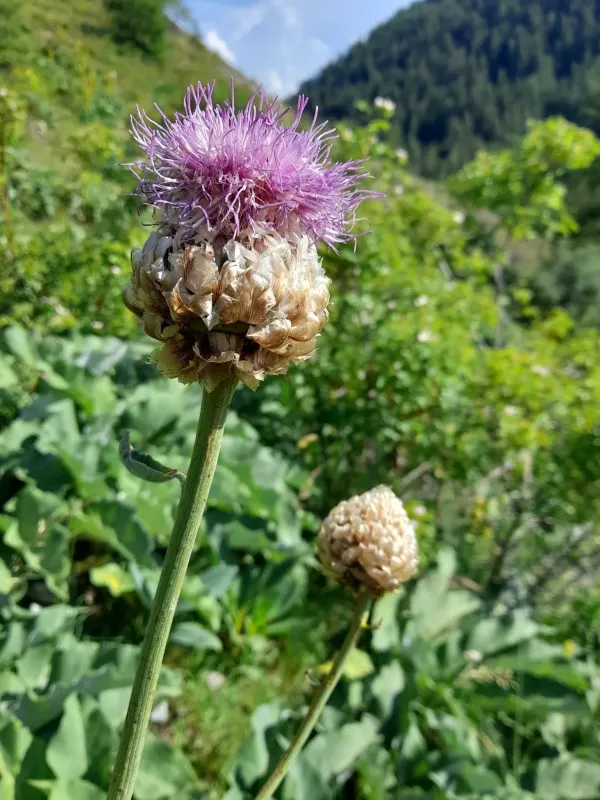
Description
Sowing dates
Helen-leaf rhaponticum is a perennial herbaceous plant belonging to the Asteraceae family. In agricultural practice, crop propagation is most often carried out by seeds, and less frequently by the vegetative division of rhizomes.
Sowing seeds in open ground is primarily conducted in the autumn before winter or in early spring, as soon as the soil warms up to 5-8 degrees Celsius. It is important to ensure sufficient seed stratification to increase germination rates.
For establishing plantations, a wide-row sowing method with row spacing of up to 60 centimeters is recommended. This provides an optimal feeding area for the plant's robust root system and facilitates subsequent mechanized care.
The seeding depth should be no more than 1-2 centimeters so as not to hinder the emergence of seedlings. The soil should be well moistened immediately before sowing and compacted with a roller to improve seed-to-substrate contact.
In the first year of life, the crop develops slowly, forming a rosette of basal leaves. During this period, it is critically important to ensure weed control in the area, as seedlings are extremely sensitive to competition from weeds.
Growing requirements
Helen-leaf rhaponticum is a mountain plant, therefore it imposes specific requirements on growing conditions. The crop prefers well-drained, fertile loamy or sandy loam soils with a neutral or slightly acidic reaction.
The plant possesses high frost resistance and is capable of surviving harsh winters, making it promising for cultivation in temperate climates. However, excessive moisture and stagnant water in spring are detrimental to the rhizomes.
Light exposure plays an important role in the accumulation of biologically active substances. The best yield indicators are achieved in open, sunny areas protected from drying cold winds.
A critical factor is soil structure: it must be loose to ensure oxygen access to the root system. Applying organic fertilizers before planting contributes to the intensive development of both the above-ground biomass and the roots.
The crop responds positively to regular irrigation during dry periods, especially during the active vegetative growth phase and the onset of flowering. Optimal moisture levels allow for consistently high yields of medicinal raw materials.
Yield
The yield of Helen-leaf rhaponticum depends directly on the age of the plantation and compliance with agronomic standards. Starting from the second year of life, the plant actively increases its biomass, which allows for the first industrial harvest.
The main value lies in the roots and rhizomes, which accumulate ecdysteroids and flavonoids. The average yield of dry raw material per hectare of plantation can range from 1.5 to 3 tons, depending on the intensity of fertilizer application.
Maximum root mass productivity is observed at 3-4 years of cultivation. Keeping the plantation in the same place for longer than five years is not recommended, as this leads to a decrease in the concentration of useful substances and aging of the rhizomes.
Leaf and stem biomass can also be used, although demand for these is lower than for the underground parts. Overall crop productivity, with proper care, allows for economically justified income in intensive cultivation systems.
Factors limiting yield include a lack of microelements in the soil and incorrect irrigation regimes. Conducting foliar feeding during the budding phase can increase the output of marketable raw materials by 10-15 percent.
Main diseases and pests
Helen-leaf rhaponticum is generally a resilient crop, but it suffers from fungal diseases if agronomic practices are not followed. This primarily concerns root rots, which arise from soil waterlogging.
Powdery mildew can affect the leaf apparatus in conditions of high humidity and stagnant air. For prevention, it is necessary to follow crop rotation and avoid overcrowding the plantings, ensuring free air circulation.
Among pests, the greatest danger is posed by insects that damage the roots. Wireworms and May beetle larvae can significantly reduce plant density in the plantation by boring tunnels in the rhizomes.
Aphids and other sucking pests can attack young shoots in the spring, leading to leaf deformation and plant weakening. Monitoring pest populations allows for the timely application of biological protection methods.
To combat diseases and pests, preference should be given to an integrated plant protection system, minimizing the use of pesticides to maintain the quality of the valuable medicinal raw material.
Harvesting
Harvesting of rhizomes is carried out in the autumn after the completion of vegetation, when the above-ground part begins to die off. It is during this period that the maximum concentration of active substances is observed in the underground organs.
For excavating the roots, specialized shovels or potato diggers are used, which allow for the full extraction of raw materials from the soil with minimal mechanical damage. Damaged parts can become a source of decay during storage.
After harvesting, the rhizomes must be thoroughly cleaned of soil and washed with running water. The operation should be carried out promptly to prevent the onset of oxidation processes and the loss of raw material quality.
Drying is performed in ventilated rooms or special dryers at a temperature not exceeding 45-50 degrees Celsius. It is important not to allow overheating, as this destroys the temperature-sensitive ecdysteroids.
After drying, the raw material is sorted, removing impurities and unsuitable fragments. Storage is carried out in dry, dark, and well-ventilated warehouse facilities in compliance with product compatibility requirements.