

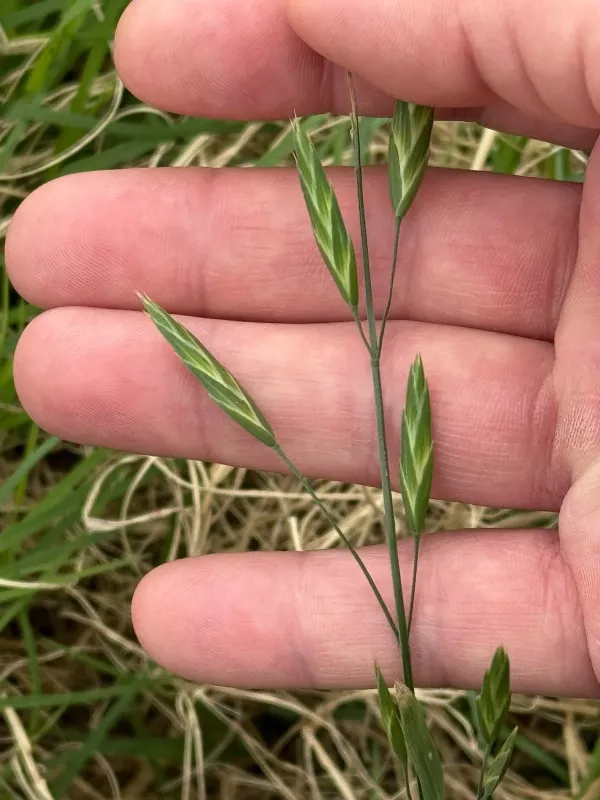
Description
Sowing dates
The optimal time for sowing Smooth Brome (Bromus inermis) is in early spring, as soon as the soil is dry enough for tillage. Planting early allows the plants to establish a robust root system by utilizing winter moisture, which is vital for long-term survival and vigor.
In regions with sufficient moisture, late summer sowing in July or August is also highly effective, particularly after the harvest of small grain crops. It is crucial that the plants reach the tillering stage before the first frost to ensure they enter winter with enough stored energy.
Dormant seeding in late autumn is another viable option, especially in areas with loose soil prone to spring droughts. Seeds are planted just before the ground freezes, ensuring they remain dormant until favorable spring temperatures trigger germination.
The seeding rate varies based on the method: 15–20 kg/ha is standard for broadcast or solid-seeded drills, while row seeding can be reduced to 8–10 kg/ha. Lower rates in row cropping promote better individual plant development and access to soil nutrients.
Planting depth should be kept between 1 and 3 cm depending on soil texture. On heavy clay soils, shallow planting is essential to avoid seedling emergence failure, while on sandy soils, slightly deeper planting helps protect the developing roots from rapid surface drying.
Growing requirements
Smooth brome is a highly adaptable perennial grass belonging to the Poaceae family. It is renowned for its extreme winter hardiness, allowing it to thrive in the harsh climates of the Northern Hemisphere, where other forage grasses often fail to survive.
The crop performs best on deep, fertile soils like chernozems or well-drained loams. While it can handle periodic flooding, it is sensitive to waterlogged, acidic, or saline conditions. Good soil drainage is key to maintaining long-term stands of this grass.
One of the most notable features of smooth brome is its drought tolerance, supported by an extensive network of creeping rhizomes. These rhizomes allow the grass to tap into deep soil moisture, sustaining green growth during the peak of summer heat.
Smooth brome requires full sun for optimal biomass production; therefore, it should not be planted under dense canopy or in heavily shaded areas. In its second year, it typically forms a thick sod that effectively competes with most annual and perennial weeds.
Nutrient management is essential for maintaining high yields over multiple years. Regular applications of nitrogen-rich fertilizers are recommended to stimulate biomass regrowth after grazing or harvesting, ensuring the forage quality remains consistently high.
Yield
Yield potential of Smooth Brome depends heavily on soil quality, annual rainfall, and the intensity of fertilization. Under intensive management, farmers can achieve two to three cuttings per growing season, providing a steady supply of high-quality forage.
Average hay yields typically range from 4 to 6 tons per hectare under favorable conditions. It is important to note that the yield usually peaks between the third and fifth years of establishment, after which renovation or overseeding may be needed to maintain vigor.
When used for pasture, smooth brome offers excellent palatability and regrowth potential after grazing. Its ability to tolerate frequent defoliation makes it a perfect component for grazing-hay rotations, supporting a reliable green feed cycle for livestock.
Nutritional value peaks during the late vegetative phase or at the very beginning of the heading stage. Harvesting at this specific time ensures the highest protein content and digestibility, which is critical for maximizing livestock weight gains.
Seed production yields range from 300 to 500 kg/ha depending on management. Specialized seed plots require precise timing and protection from pests to ensure the viability and quality of the harvest for future planting seasons.
Main diseases and pests
Diseases such as leaf spot (Helminthosporium and Rhynchosporium) can affect Smooth Brome, particularly during warm, humid periods. These diseases reduce photosynthetic capacity by damaging the foliage, leading to a loss in both biomass and forage quality.
Rust diseases (leaf and stem rust) are common in many regions and can cause significant damage to the crop. Selecting resistant varieties is the most effective defense strategy against these fungal pathogens in commercial production.
Smut can infect the seed heads, replacing grains with fungal spores. To prevent the spread of these pathogens, growers should ensure that seed stocks are treated with appropriate fungicides and that healthy, disease-free crops are used for propagation.
Insects like grass flies, leafhoppers, and various species of bugs can pose a risk to both vegetative and reproductive stages. Managing these pests requires a combination of crop rotation and targeted monitoring during the early spring growth flush.
Integrated Pest Management (IPM) practices, including the maintenance of vigorous plant health through balanced fertilization and proper harvest timing, provide the best protection against typical grass pests and diseases in a forage system.
Harvesting
The most important phase for harvesting Smooth Brome for hay is the early heading stage. Harvesting at this time balances the need for maximum biomass with the requirement for high nutrient density, ensuring the resulting hay is palatable and nutritious.
Using mower-conditioners is highly recommended, as the conditioning process cracks the stems, allowing moisture to escape faster. This method minimizes field drying time and reduces the risk of nutrient leaching due to rainfall exposure.
Moisture content at baling should be below 17% to prevent mold growth and heating inside the bales. Using tedders to turn the swaths speeds up the drying process and ensures that the forage quality is preserved as uniformly as possible.
For seed production, the crop should be harvested at physiological maturity when the panicles turn a straw-yellow color. Because the seeds can shatter easily, timely action is necessary to prevent significant yield losses during the harvest operation.
Direct combining is possible, but swathing (windrowing) followed by combine harvesting is often preferred to minimize seed shatter losses and ensure uniform maturity across the field. Post-harvest, seeds must be cleaned and dried to maintain high germination rates.
Content graph
Connections · Smooth brome
Most often together:
Marketplace
Products · 5

Selenit
«Нанджин Ессенс Файн-Кемікал Ко. Лтд» (Китай)
Herbicides
0
0
·
1.4K
4 offers
12.11 €per 1 l
Buy


