
Kerner's Lousewort
Pedicularis kerneri
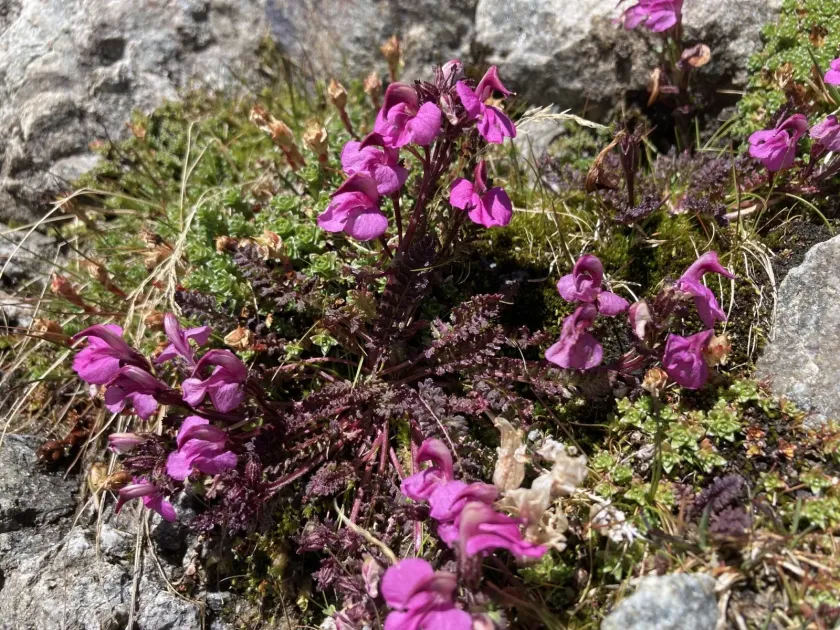
Description
Growing requirements
Kerner's Lousewort (Pedicularis kerneri) is a perennial herbaceous plant belonging to the Orobanchaceae family. It is recognized as a hemiparasite, meaning it derives partial nutrition through root connections with other vascular plants in its ecosystem.
The species is primarily native to the high-altitude regions of the European Alps. It typically occupies alpine meadows, rocky slopes, and ridges, thriving in environments where other competitive vegetation is sparse or limited by extreme conditions.
The plant exhibits specific botanical adaptations, including a compact growth form and highly specialized roots. Its morphology is perfectly suited to survive the short growing season and the harsh, high-wind conditions prevalent in alpine zones.
Regarding cultivation requirements, the plant demands well-draining, rocky, and nutrient-poor soils. It is highly sensitive to the soil chemistry and relies on high levels of solar radiation and specific temperature cycles characteristic of its native high-altitude habitat.
There is currently no agricultural industry standard for the mass production of Pedicularis kerneri. Its role remains focused on ecological preservation and as a component of sensitive high-altitude alpine biodiversity conservation efforts.
Main diseases and pests
Climate change poses a significant threat as rising temperatures allow more aggressive, non-alpine plant species to migrate into the higher elevations, displacing Kerner's Lousewort.
Overgrazing by domestic livestock in alpine pastures causes severe damage to the plant's delicate root system and reduces the availability of suitable host plants for nutrient exchange.
Pathogenic fungi can infect the plant during periods of prolonged snowmelt or excessive moisture, which may lead to root rot and complete failure of the population in specific zones.
Various mountain insects act as pests, primarily targeting the inflorescence, which hampers seed production and limits the plant's ability to propagate naturally.
Human intervention, including tourism infrastructure development in fragile alpine zones, poses a risk of habitat fragmentation and direct damage to local populations.