
Hoermann's lousewort
Pedicularis hoermanniana
Description
Growing requirements
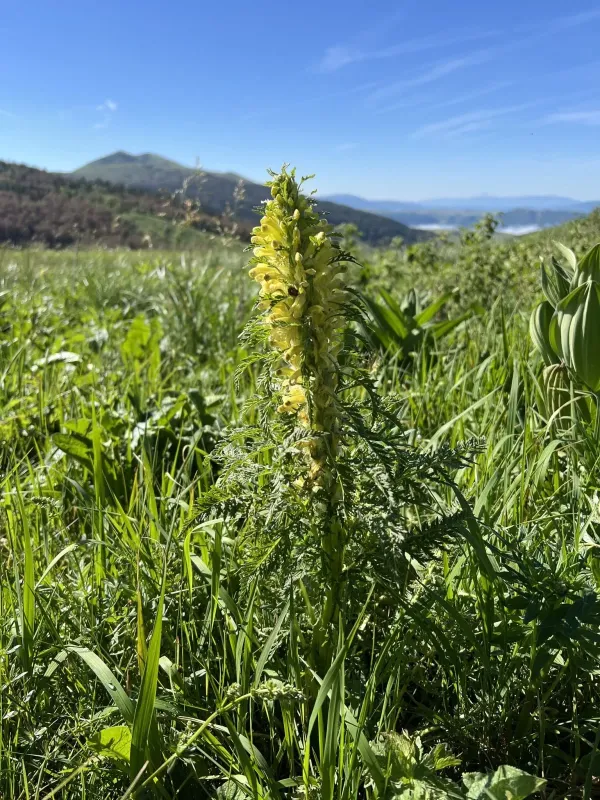
Hoermann's lousewort (Pedicularis hoermanniana) is a perennial herbaceous plant belonging to the Orobanchaceae family. This species is biologically classified as a hemiparasite, meaning it derives a portion of its water and mineral nutrients by attaching to the root systems of host plants through specialized structures called haustoria.
The native distribution area of this species is highly localized, found primarily in the high-altitude mountainous regions of the Balkan Peninsula. It thrives in subalpine and alpine meadows, where it has evolved to withstand harsh climatic conditions such as strong winds, low temperatures, and fluctuating moisture levels typical of high-elevation environments.
Soil requirements for this plant are stringent, favoring well-drained, rocky, and low-nutrient substrates found in undisturbed mountain ecosystems. The plant cannot be grown in isolation; it requires the presence of compatible host vegetation, making traditional agricultural cultivation methods completely inapplicable to this species.
From an agrotechnical perspective, there are no established practices for the cultivation of Pedicularis hoermanniana. Any efforts to maintain the species outside of its natural habitat require advanced environmental controls that simulate the specific mycorrhizal and biotic interactions present in high-altitude alpine zones.
The plant has no economic value or agricultural utility in terms of food or raw material production. Its significance is purely academic and conservation-based, serving as a subject of study for botanists interested in the evolution, parasitic strategies, and ecological roles of mountain flora in fragile alpine environments.