
Pedicularis exaltata
Pedicularis exaltata
Description
Growing requirements
Pedicularis exaltata, commonly known as a species of lousewort, is a perennial hemiparasitic herb belonging to the family Orobanchaceae. Unlike conventional crops, this plant functions by attaching its roots to the root systems of surrounding meadow plants to obtain water and minerals.
The origin of this species is associated with temperate zones in Eurasia. It typically inhabits moist meadows, forest clearings, and riparian zones where the density of host plants is sufficient to sustain its hemiparasitic lifestyle throughout the growing season.
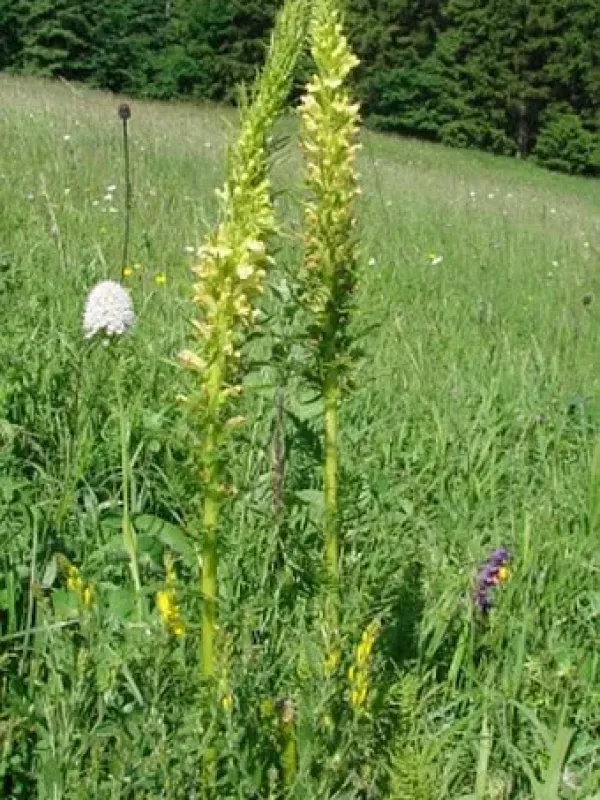
Botanically, the plant is characterized by an erect stem that can reach significant heights, often exceeding 80–100 cm. Its foliage is finely divided, and its flowers are arranged in dense terminal spikes, featuring the typical morphological structure of the genus Pedicularis.
Climatic and soil requirements are strictly linked to high-moisture environments. The plant thrives in humus-rich, slightly acidic to neutral soils that maintain consistent moisture levels. It is highly sensitive to soil compaction and drought, which directly impair its ability to attach to host roots.
The agricultural significance of Pedicularis exaltata is negligible, as it is not a cultivated crop. However, in ecological research, it serves as an important subject for understanding nutrient transfer between species and the complexity of vegetation dynamics in natural grassland ecosystems.