
Canadian lousewort
Pedicularis canadensis
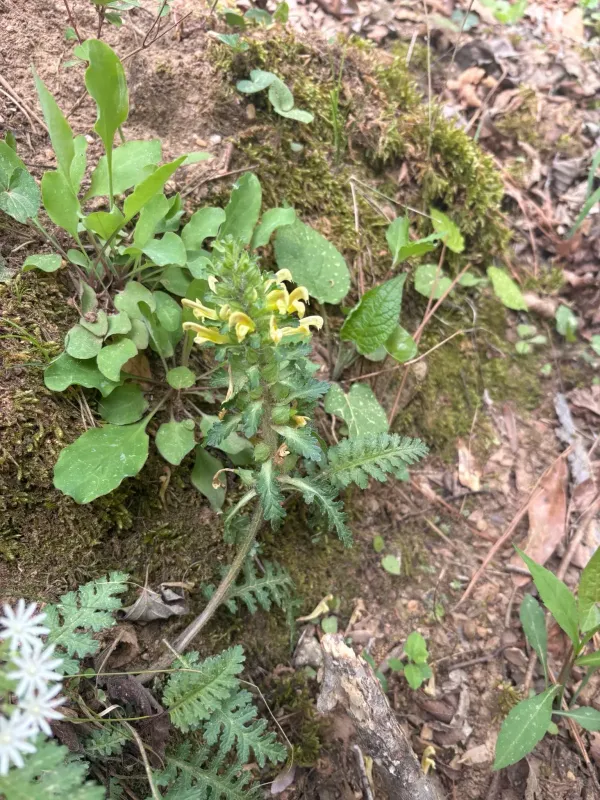
Description
Growing requirements
Canadian lousewort (Pedicularis canadensis) is a perennial herbaceous plant belonging to the Orobanchaceae family. It is widely recognized as a facultative hemi-parasite, meaning it can photosynthesize independently but relies on attaching its roots via haustoria to the root systems of various host plants to obtain extra water and nutrients.
Native to North America, the species is found across a wide range of habitats, including open woodlands, dry-to-mesic prairies, and meadows. It is highly adaptable to varied light conditions, thriving in environments that range from full sun to dappled shade, provided its host plants are present.
Botanically, the plant features a basal rosette of fern-like leaves and a stout, pubescent stem producing dense, terminal spikes of yellow or reddish-brown flowers. These flowers are uniquely shaped to be pollinated primarily by bumblebees, which push their way into the blossom to access nectar.
In terms of soil requirements, Pedicularis canadensis prefers well-drained, sandy-loam soils that are slightly acidic to neutral. Since it is a semi-parasite, it cannot be successfully cultivated in isolation; its establishment depends entirely on the availability of compatible companion plants in the soil.
Agronomically, this plant is not a crop in the traditional sense but is highly valued in habitat restoration projects. When integrating it into managed landscapes, one must ensure a diverse plant community is established beforehand to provide the necessary host support for the lousewort to flourish.
Main diseases and pests
The primary threat to Canadian lousewort populations is habitat fragmentation and the loss of native prairie ecosystems. When host plant communities are disrupted or destroyed for agricultural or urban development, the lousewort is typically the first species to disappear due to its nutritional dependency.
Disease-wise, the plant is relatively resilient but can be susceptible to fungal pathogens like powdery mildew in environments with poor air circulation or excessive humidity. Rotting of the root system can also occur if the soil remains waterlogged for extended periods, stressing both the parasite and its host.
Insect pests include various lepidopteran larvae that feed on the foliage and flower stalks. While herbivory is a natural process in prairie ecosystems, intense grazing or localized outbreaks of pests can reduce the vigor of the plant, potentially shortening the duration of its blooming period.
Competition from aggressive non-native weeds poses a significant challenge. These invasive species often lack the compatibility to serve as hosts, effectively starving the Pedicularis canadensis by outcompeting its root system for space and soil moisture, leading to population decline.
Climate instability, particularly during the early growing season, can be detrimental. Extended periods of drought limit the growth of the host species, which in turn restricts the amount of resources the lousewort can extract, often resulting in smaller plant size and reduced seed set.