
Oxytropis psammocharis
Oxytropis psammocharis
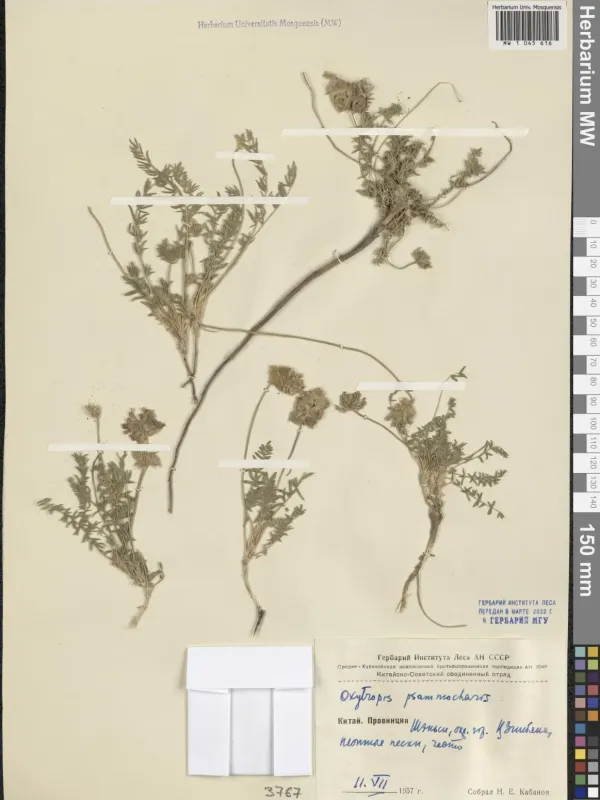
Description
Sowing dates
Oxytropis psammocharis is a perennial herb belonging to the Fabaceae (legume) family. It possesses a deep taproot system, which allows the plant to adapt successfully to challenging and nutrient-poor environments.
In field conditions, propagation is mainly achieved through seeds. The ideal sowing period is early spring, as soon as the soil warms up to 5–8 degrees Celsius, enabling the plant to utilize seasonal moisture for germination.
The seeds have a hard seed coat and require scarification to improve germination rates. When planting in light soils, seeds should be sown at a depth of 2–3 centimeters, followed by mechanical rolling to ensure good soil-to-seed contact.
For standard row planting, a seed rate of 8–10 kg per hectare is recommended. Using a wider row spacing can reduce seed consumption and improve airflow, which is beneficial for the development of individual plants.
The crop grows slowly during the first year of establishment. Therefore, weed management through timely inter-row cultivation or light harrowing is essential to prevent competitive weeds from suppressing young seedlings.
Growing requirements
This species is a typical xerophyte, highly adapted to sandy and rocky soils. It demonstrates exceptional resilience against prolonged droughts and high temperatures, making it suitable for arid regions.
The plant requires full sun exposure for optimal growth. It is highly sensitive to shading, which significantly inhibits its biomass production and the formation of flowers and seeds.
Oxytropis psammocharis prefers well-aerated sandy or loamy soils with a neutral or slightly alkaline pH. It is extremely tolerant of low-fertility soils and is often used for site restoration purposes.
Excessive soil moisture and high water tables are detrimental to the species, as they often lead to root rot and other fungal diseases that can rapidly destroy a stand.
The plant is highly frost-tolerant and can survive harsh winter conditions. It exhibits early spring regrowth once consistent positive temperatures are established, showing high metabolic activity at low temperatures.
Yield
The primary agricultural use of this crop is phytomelioration—stabilizing mobile sands and preventing soil erosion. Its extensive root network effectively binds loose soil particles, protecting them from wind damage.
As a forage crop, it provides a valuable protein source for small ruminants like sheep and goats in arid pasture systems. Its green mass is particularly nutritious during the early growth stages.
Biomass yields vary depending on moisture and soil conditions, typically ranging from 30 to 70 quintals per hectare. Harvest for hay is most productive during the mass flowering phase.
Seed production is stable under favorable conditions. Harvesting should be carefully timed to coincide with the maturity of the pods to ensure high quality and volume of the collected material.
Incorporating this legume into crop rotations benefits the soil by increasing nitrogen levels through symbiotic fixation, which enhances the overall fertility and sustainability of the cropping system.
Main diseases and pests
Fungal diseases, including leaf spots and powdery mildew, represent the main threat to this crop, especially in years with high humidity or poor field drainage that promotes pathogen development.
Weevils are among the most problematic pests, specifically targeting the reproductive structures of the plant and significantly reducing seed yields. Integrated pest management is recommended for effective control.
Aphids can cause damage to young shoots during hot, dry spells by extracting plant sap. Consistent field scouting is necessary to trigger timely interventions if thresholds are exceeded.
Parasitic plant species, such as broomrape, can infest stands and drain nutrients directly from the roots, leading to reduced vigor and potentially thinning the plant population over time.
Chemical control should be used sparingly and only as a last resort, as the species is often grown in ecologically sensitive environments where chemical residues could disrupt local biodiversity.
Harvesting
The optimal time for harvesting hay is at the beginning of the flowering phase, ensuring a balance between biomass volume and nutritional quality. Standard mowing equipment is usually sufficient.
Seed harvesting requires caution due to the risk of pod shattering. It is best conducted in the early morning when humidity levels help keep the pods intact, or by using combines with specialized settings.
After collection, seeds must be cleaned and dried to a moisture content of around 12% to ensure long-term storage viability. Proper storage in cool, ventilated areas prevents heating and mold.
Maintaining proper storage conditions is crucial for retaining seed germination rates for future seasons. Seeds should be stored in containers that prevent moisture absorption during the winter months.
Post-harvest residues can be used as organic mulch to help retain moisture in sandy soils, which facilitates the growth and survival of the crop or subsequent vegetation in the next cycle.