
Fumana procumbens
Fumana procumbens
Description
Growing requirements
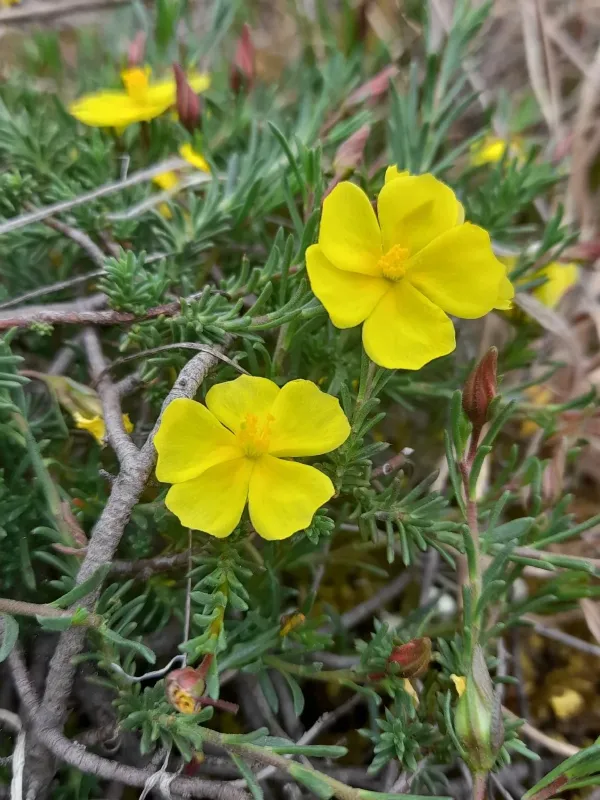
Fumana procumbens is a perennial subshrub belonging to the Cistaceae family. Known for its prostrate growth habit, it forms low, dense mats or cushions, making it a distinctive plant in its native habitats. It is biologically adapted to harsh, dry conditions.
The native range of this species covers much of Europe, the Mediterranean region, and parts of Western Asia. It is typically found in dry grasslands, rocky limestone slopes, and open, sun-exposed terrains where other vegetation struggles to survive due to nutrient deficiency.
Regarding soil requirements, Fumana procumbens demands well-drained, lime-rich, or sandy substrates. It is a true xerophyte that cannot tolerate "wet feet" or prolonged moisture in the root zone, as poor soil drainage leads to rapid root decay and death.
The plant is not classified as a standard agricultural crop but has value in landscaping and rock gardens. It is used as a ground cover in xeriscaping, where its ability to survive in arid, mineral-heavy soils provides both aesthetic appeal and soil stability.
Direct sunlight is the most critical environmental requirement for this species. It requires full sun exposure for the majority of the day to thrive, flower, and maintain its compact, healthy structure. Lack of light results in sparse foliage and increased susceptibility to disease.
Main diseases and pests
The primary threats to Fumana procumbens include habitat fragmentation and the loss of traditional open-space management. Being a plant of open landscapes, it struggles when its habitat is overtaken by taller shrubs or invasive weed species due to changes in land use.
Fungal pathogens represent the main disease threat, usually triggered by excessive humidity or poor ventilation. If the plant is kept in conditions that prevent quick evaporation after rain, root and collar rot become serious risks that often result in plant mortality.
Pests are rarely a major concern for Fumana procumbens. Its leaves are protected by natural compounds, including essential oils, which discourage many generalist herbivores. However, in extreme drought, localized infestations of sap-sucking insects might occur.
Preventive care is essential for maintaining healthy populations. This involves ensuring that the plant is located in an area with excellent air circulation and perfect drainage. Avoiding nitrogen-rich fertilizers is crucial, as they promote weak, succulent growth that is more prone to damage.
Human activity, particularly heavy foot traffic, poses a direct threat to the plant's delicate stems and roots. Protecting the integrity of its stony substrate is vital for its long-term survival in natural environments, as soil compaction effectively kills its shallow root system.