
Crofton weed
Eupatorium adenophorum Spreng.
Description
Growing requirements
Crofton weed (Eupatorium adenophorum) is a perennial herbaceous plant belonging to the Asteraceae family. Originating from Mexico, it has become a globally recognized invasive species, spreading across tropical and subtropical regions worldwide.
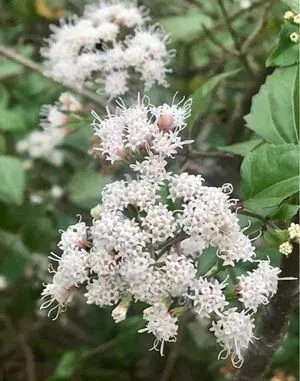
The plant grows as an erect shrub, reaching heights of up to two meters. It features opposite, serrated leaves and clusters of small white flowers. The stems are often purplish and covered in fine, sticky glandular hairs, which give the plant its characteristic scent and name.
Crofton weed thrives in various environmental conditions, exhibiting high adaptability to different soil types. It is particularly aggressive in colonizing disturbed land, pastures, and forest edges, where it creates dense thickets that prevent other species from establishing.
Regarding climate, it prefers areas with high humidity and consistent rainfall, though it can withstand moderate dry periods. It is highly efficient at photosynthesizing, which allows it to outcompete native vegetation for light and nutrients in diverse habitats.
In agricultural contexts, this plant is considered a significant nuisance. It possesses toxic properties that make it hazardous to livestock, causing chronic health issues or death when ingested by cattle or horses, thus severely impacting pasture management and grazing safety.
Main diseases and pests
There are no significant diseases that naturally control Crofton weed populations in its invasive range. The plant's hardy nature makes it highly resilient against common agricultural pathogens, allowing it to maintain dominance in established areas.
Insect pests are largely ineffective against the weed in new territories due to the absence of specific co-evolved herbivores. Biological control efforts have focused on introducing host-specific insects, such as the gall fly, to limit its vegetative spread.
The primary threat to crops is the weed's ability to create monocultures, rapidly invading land and reducing available space for productive grasses. This encroachment leads to decreased pasture carrying capacity and increased maintenance costs for farmers.
Managing the weed is difficult because of its persistent root system and prolific seed production. Millions of wind-dispersed seeds can infest surrounding fields, necessitating a proactive and landscape-wide approach to control.
Control strategies often require a combination of herbicides and mechanical removal. Because the plant recovers quickly from top-growth damage, total removal or repeated suppression during the vegetative stage is essential to prevent maturation and further seed dispersal.