
Calamus diepenhorstii
Calamus diepenhorstii
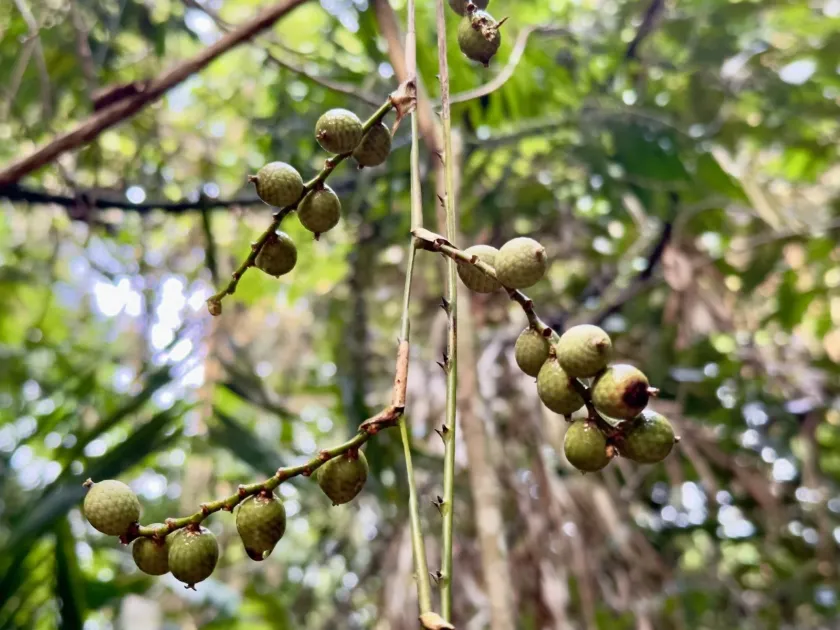
Description
Growing requirements
Calamus diepenhorstii is a species of climbing palm belonging to the Arecaceae family. In its natural habitat, it acts as a robust liana, using its specialized hooked organs to climb through the canopy of tropical rainforests in Southeast Asia.
The cultivation of this plant requires specific environmental conditions found in humid tropical zones. It thrives in locations with consistently high temperatures and significant annual rainfall, as it is highly sensitive to drought and extreme thermal fluctuations.
Soil requirements for Calamus diepenhorstii involve deep, well-drained, and nutrient-rich substrates, typically found in lowland tropical forests. While it prefers moist environments, adequate soil drainage is essential to prevent root rot, which is a common issue in poorly managed plantations.
In terms of light, the plant prefers dappled shade in its juvenile stage to mimic the natural forest floor conditions. As it matures, the liana requires access to vertical light and strong support structures to develop long, uniform, and commercially viable stems.
Agricultural management includes regular soil monitoring and the application of organic matter to maintain fertility. Plantations should be designed to allow for proper airflow, which helps in preventing fungal issues and ensures the healthy growth of the palm stems.
Harvesting
The primary economic value of Calamus diepenhorstii lies in its stems, widely known in the trade as rattan. These stems are highly valued for their exceptional strength, flexibility, and resistance to environmental stress, making them ideal for high-end furniture crafting.
Harvesting involves the selective cutting of mature stems. Workers remove the spiny leaf sheaths before the stems undergo processing. The primary processing steps include washing, boiling in oil or steam to remove excess moisture and pathogens, and sun-drying to stabilize the material.
The quality of the final product is assessed based on the diameter of the stem, the smoothness of the surface, and the uniformity of the internodes. The processed rattan can be split or used as a whole pole, depending on the specific industrial requirement.
Proper harvest cycles are crucial to ensure sustainability. Over-harvesting can lead to the decline of local populations, so rotational harvesting strategies are recommended to allow the palm clusters to regenerate and maintain long-term productivity.
The rattan market depends heavily on the durability of the raw material. Calamus diepenhorstii stands out for its structural integrity, which makes it a preferred choice for manufacturers producing long-lasting, durable, and lightweight interior furnishings.