
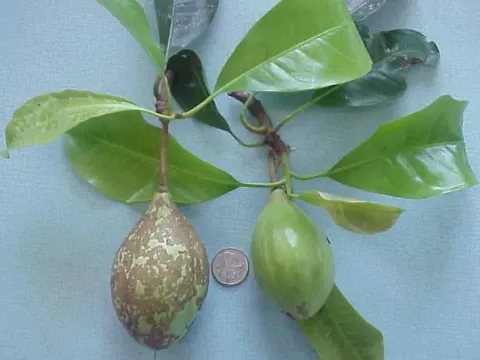
Burckella
Burckella
Burckella is a genus of evergreen trees belonging to the Sapotaceae family, native to the tropical forests of the Pacific Islands and Southeast Asia. These trees are known for their robust growth and ability to thrive in dense, competitive forest environments.
What the section contains

Burckella
The cultivation of Burckella requires a tropical climate with high temperatures and consistent annual rainfall. They are highly sensitive to frost and require sheltered positions if grown in areas with strong winds, as the trees are typically adapted to the understory or canopy of rain forests.
Soil requirements include well-drained, nutrient-rich substrates, preferably with a slightly acidic to neutral pH. They perform best in deep soils that can retain moisture without becoming waterlogged, which mimics their natural habitat in the Pacific region.
Botanically, these trees feature dense, dark green foliage and produce substantial fleshy fruits. Their wood is recognized for its durability and structural strength, frequently utilized by local communities for building purposes.
The agricultural potential of Burckella lies in both its edible fruit, which provides a source of nutrition, and its timber value. Though not widely industrialized, it remains a significant subsistence crop in its native range.
Harvesting Burckella fruits is typically performed by hand due to the stature of mature trees. Harvesters must carefully climb or use support structures to access the canopy where the fruits are produced in abundance.
Timing the harvest is crucial, as the fruits must reach physiological maturity to ensure optimal sweetness and texture. Over-ripening can lead to rapid deterioration on the tree, especially in high-humidity environments.
Post-harvest handling involves gentle cleaning and sorting to separate damaged fruits from prime produce. Given the perishability of tropical fruits, immediate local processing or consumption is the most common practice.
Storage should prioritize air circulation to prevent mold growth, which is a common threat in tropical harvest conditions. No advanced machinery is currently standard for these trees, keeping the process artisanal.
Producers often process the fruit into pulp or sun-dried forms to extend shelf life for trade or future use, ensuring minimal waste of the valuable nutritional resource during the peak season.