
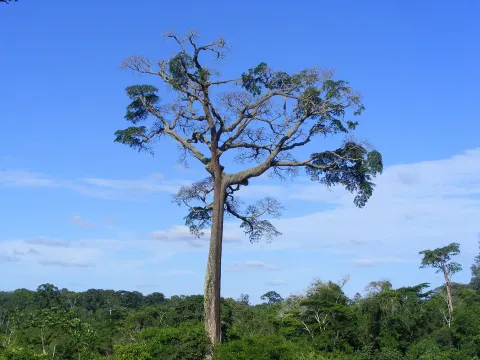
Baillonella
Baillonella
Baillonella (Baillonella toxisperma) belongs to the Sapotaceae family. It is a massive tropical tree that can reach heights of up to 50 meters in its natural habitat, standing as one of the largest representatives of African rainforests.
What the section contains

Baillonella
The culture thrives primarily in equatorial Africa, including countries such as Gabon, Cameroon, Congo, and Angola. The tree prefers moist tropical lowlands with deep, humus-rich soils and high annual temperatures with no distinct seasonal fluctuations.
Due to its biology, Baillonella is a wild species adapted to life under the forest canopy during its early stages. Successful development requires a stable level of air humidity and protection from direct sunlight in the early phases of growth.
Agrotechnical cultivation of this tree is extremely difficult due to its slow growth rate and specific requirements for mycorrhiza. Traditionally, harvesting is carried out by local populations in areas of natural growth, which limits the possibilities for intensive commercial farming.
The tree possesses high ecological value, acting as a keystone species in the ecosystem. Thanks to its deep root system, it effectively prevents soil erosion, making it an essential subject for restoration programs of degraded tropical landscapes.
The main economic product is the seed, which contains up to 60% of high-quality fatty oil, known as makore oil. The seeds are round and possess high nutritional value, being rich in fatty acids and vitamins.
Makore oil is widely used in the cosmetics industry due to its emollient and restorative properties. It is actively utilized in the production of creams, lotions, and hair care products, and is also valued in the culinary traditions of Central African countries.
Baillonella timber is characterized by high strength, density, and resistance to decay. It is traditionally used in construction, high-quality furniture making, and woodworking, making the tree an object of active exploitation in the forestry sector.
Beyond oil and wood resources, the tree's fruit serves as an important food source for many wild animals, including elephants and gorillas, which play a crucial role in seed dispersal within forest tracts.
The economic potential of the culture lies in the rational use of non-timber forest resources. Sustainable harvesting of fruits provides long-term income for local communities, encouraging the preservation of forest areas rather than their complete clearing for timber.
The primary threat to the Baillonella population is uncontrolled logging for its valuable timber. Because the trees grow extremely slowly and take decades to reach maturity, forest regeneration after intensive logging is almost impossible through natural processes.
Common diseases are mainly associated with fungal infections of the wood caused by mechanical damage to the trunk. The humid tropical environment facilitates the rapid development of rot if the protective bark layer is compromised by pests or human activity.
Pests include various species of tropical wood-boring insects that can damage the bark and phloem. However, the main losses are linked less to parasites than to competition for light and nutrients in dense forest thickets.
Climate change, leading to prolonged droughts in the growth range, negatively affects fruit yields. The tree is sensitive to disruptions in the hydrological regime, which can reduce the intensity of fruiting and seed viability.
The lack of effective artificial propagation technologies makes the species vulnerable to market demand for makore oil. Without implementing principles of sustainable forest management and artificial planting programs, the biodiversity of this species remains at risk of extinction.