
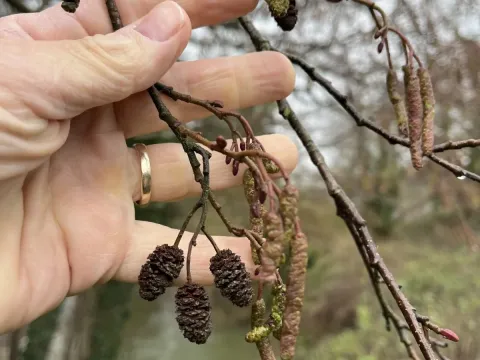
Alder
Alnus Mill.
Sowing alder seeds in nurseries is typically performed in spring, once the soil has warmed up to 8-10 degrees Celsius. To achieve uniform germination, seeds undergo stratification, which lasts from one to three months in a moist environment at low temperatures.
What the section contains
 Andean alder
Alnus acuminata Kunth
Andean alder
Alnus acuminata Kunth
 Andean alder
Alnus jorullensis Kunth
Andean alder
Alnus jorullensis Kunth
 Black alder
Alnus glutinosa (L.) Gaertn.
Black alder
Alnus glutinosa (L.) Gaertn.
 Green alder
Alnus viridis (Chaix) DC.
Green alder
Alnus viridis (Chaix) DC. subsp. viridis
Green alder
Alnus viridis (Chaix) DC.
Green alder
Alnus viridis (Chaix) DC. subsp. viridis
 Grey alder
Alnus incana (L.) Moench
Himalayan alder
Alnus nitida (Spach) Endl.
Grey alder
Alnus incana (L.) Moench
Himalayan alder
Alnus nitida (Spach) Endl.
 Italian alder
Alnus cordata (Loisel.) Duby
Italian alder
Alnus cordata (Loisel.) Duby
 Lusitanian alder
Alnus lusitanica Vít et al.
Lusitanian alder
Alnus lusitanica Vít et al.
 Red alder
Alnus rubra Bong.
Red alder
Alnus rubra Bong.
Alder
The sowing depth is 0.5–1 cm, as alder seeds are small and sensitive to soil density. After sowing, the surface is mulched with a layer of peat or sawdust to maintain optimal moisture in the topsoil horizon.
In natural conditions, alder propagates by seed and also actively uses vegetative methods through root suckers. In forest plantations, nursery-grown seedlings aged 1–2 years are most commonly used.
When establishing commercial plantations, it is important to observe planting density, taking into account the species' rapid growth. The optimal scheme involves spacing seedlings at intervals of 1.5 to 2.5 meters between rows.
Alder is a fast-growing species, so maintenance on degraded lands requires minimal effort after crown closure, as the crop effectively suppresses weed development.
Alder is a member of the Betulaceae family, characterized by high requirements for soil and air moisture. It prefers well-aerated but moist substrates, often growing along riverbanks and in swampy areas.
The culture has a unique ability to fix atmospheric nitrogen through symbiosis with actinomycetes of the genus Frankia living on its roots. This allows alder to successfully develop in nitrogen-poor soils, enriching them with organic matter.
Regarding light requirements, alder is a light-demanding species, though it tolerates slight side shading in its youth. Lack of light leads to reduced growth intensity and premature dieback of lower branches.
The plant is well-adapted to various soil types, including peatlands and clay soils, provided there is constant moisture flow. Stagnant water negatively affects root system development and can lead to plantation loss.
Optimal climatic conditions for alder include a moderately cold climate with sufficient rainfall. In arid regions, the crop requires additional irrigation, as low air humidity suppresses physiological processes.
The economic value of alder lies in high-quality timber used in furniture production and construction. Plantation productivity depends on the harvesting age, which is usually 40–60 years.
The biological yield of alder green mass is used as fertilizer. Leaf litter, rich in nitrogen, significantly improves the structure and chemical composition of forest and agricultural soils.
In agroforestry systems, alder is used as a soil-improving species. It is capable of accumulating significant amounts of nitrogenous compounds in the soil annually, which contributes to increasing the fertility of neighboring lands.
Industrial alder harvesting is focused on the production of plywood, lumber, and high-quality charcoal. Stable biomass increment allows for long-term planning of harvesting rotations.
Plantation yield also includes the collection of medicinal raw materials. Alder catkins contain tannins and are actively used in the pharmaceutical industry to prepare astringent remedies.
One of the most dangerous diseases is Phytophthora alni, caused by water-mold organisms. This pathology leads to bark necrosis, leaf yellowing, and the subsequent death of the entire tree.
Among insect pests, the alder leaf beetle (Agelastica alni) can completely defoliate leaves, causing premature shedding. Massive infestations of this pest significantly weaken the tree's immune system.
Stem pests, such as bark beetles and longhorn beetles, infest weakened specimens. Protection of plantations is based on sanitary logging and maintaining optimal water balance in the area.
In nurseries, young seedlings can be affected by damping-off caused by soil-borne fungi of the genus Fusarium. Prevention requires crop rotation and treatment of seed material with fungicides.
Overall, alder's resistance to diseases depends on the ecological condition of the growing site. Proper agronomy and timely monitoring allow for the minimization of economic damage from biological factors.
The harvesting of alder plantations is conducted in accordance with forest management plans. The autumn-winter period is considered the optimal time for timber harvesting when sap flow is minimal, which increases raw material quality.
When harvesting alder catkins, collection is carried out in late autumn or early winter. The collected material is dried in well-ventilated rooms to avoid mold and loss of beneficial properties.
After felling, alder is capable of producing abundant stump sprouts, which allows for plantation regeneration without replanting. This management method significantly reduces reforestation costs.
To maintain plot productivity after clear-cutting, maintenance of coppice regeneration is performed. Excess shoots are thinned out, leaving the strongest specimens to form the future stand.
Timber transportation is carried out using specialized machinery, taking care not to damage the root systems of remaining trees and ensuring minimal soil compaction.