
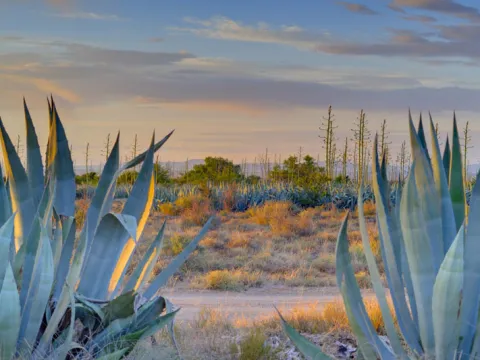
Agave
Agave
Agave is a succulent plant belonging to the Asparagaceae family. In commercial agriculture, propagation is primarily vegetative, utilizing offsets or bulbils that develop around the base of the parent plant once it reaches a certain maturity.
What the section contains
 Agave cantula
 Roxb.
Agave cantula
Agave cantula Roxb.
 Agave chiapensis
 Jacobi
Agave chiapensis
Agave chiapensis Jacobi
 Agave desmettiana
 Jacobi
Agave grijalvensis
Agave grijalvensis B. Ullrich
Agave desmettiana
Agave desmettiana Jacobi
Agave grijalvensis
Agave grijalvensis B. Ullrich
 Agave horrida
 Lem. ex Jacobi
Agave horrida
Agave horrida Lem. ex Jacobi
 Agave marmorata
 Roezl
Agave marmorata
Agave marmorata Roezl
 Agave salmiana
 Otto ex Salm-Dyck
Agave salmiana
Agave salmiana Otto ex Salm-Dyck
 Agave tuberosa
 (L.) Thiede & Eggli
Agave tuberosa
Agave tuberosa (L.) Thiede & Eggli
 Agave undulata
 Klotzsch
Agave undulata
Agave undulata Klotzsch
 Agave univittata
Agave univitatta Haw.
Agave univittata
Agave univitatta Haw.
 Bundrant's Agave
Agave x bundrantii (T. M. Howard) Thiede & Eggli
Bundrant's Agave
Agave x bundrantii (T. M. Howard) Thiede & Eggli
 Century plant
Agave americana L.
Century plant
Agave americana L.
 Fox tail agave
Agave attenuata Salm-Dyck
Fox tail agave
Agave attenuata Salm-Dyck
 Sisal agave
Agave sisalana Perrine
Sisal agave
Agave sisalana Perrine
 Squid Agave
Agave bracteosa S. Watson ex Engelm.
Squid Agave
Agave bracteosa S. Watson ex Engelm.
Agave
Planting typically takes place at the onset of the rainy season to ensure optimal establishment before the peak of the dry season. The planting density varies widely depending on the species, ranging from 2,500 to 3,000 plants per hectare for fiber-producing varieties.
Successful establishment requires careful handling of the root system during the transplanting phase. Seedlings aged 6 to 12 months are considered ideal, showing high survival rates and rapid initial growth once set in their permanent location.
While seed-based propagation is possible, it is reserved for breeding programs and specialized nurseries. Seeds require light, well-draining substrate and stable, warm temperatures to ensure uniform germination, which can be a slow process.
The adaptation period on the plantation lasts several months, during which time soil moisture must be managed carefully. Once established, the agave becomes highly resilient and requires minimal intervention, marking the start of its long vegetative phase.
Agave thrives in sunny environments with high solar radiation, which is essential for synthesizing the sugars and fibers that define its commercial value. Exposed fields with minimal shading are the standard for productive farms.
Soil quality is secondary to drainage; agave is highly susceptible to root rot if water stagnates. It prefers sandy, rocky, or limestone-rich soils that allow for deep root penetration and excellent aeration.
Temperature requirements are generally between 20 and 35 degrees Celsius. Although the crop is famous for its drought tolerance, supplemental irrigation during the initial stages of growth can significantly improve biomass production.
Soil pH should ideally be neutral to slightly alkaline. In intensive systems, maintaining the soil structure through periodic light cultivation between rows prevents crusting and encourages better gas exchange in the root zone.
Fertilization regimes are often conservative, focusing on potassium and phosphorus application to support the development of structural tissues and enhance the plant’s natural ability to withstand heat stress and variable weather conditions.
The yield of agave varies by species and intent. For fiber-producing varieties, the first commercial harvest usually occurs between 3 and 5 years after planting, with several subsequent harvests possible over the plant's lifetime.
Total green biomass yields can reach 30–50 tons per hectare. However, the commercial fiber recovery rate is relatively low, often accounting for only 3–5% of the total leaf weight, necessitating efficient byproduct management.
In the case of blue agave, cultivated primarily for the beverage industry, the yield is measured by the weight of the harvested heart or "piña." A mature plant harvested at 7–9 years can yield a piña weighing between 50 and 70 kilograms.
Yield optimization involves careful management of the harvest schedule. Harvesting too early results in low sugar or fiber content, while waiting too long can trigger the flowering process, which depletes the plant's stored reserves.
Byproduct utilization, such as converting leaf pulp into compost or animal feed, is a key component of a high-yielding plantation strategy, ensuring that nearly all parts of the plant contribute to the operation's bottom line.
The most significant threats to agave plantations are fungal pathogens such as Fusarium and Anthracnose, which flourish in high-humidity conditions and can devastate entire sections of a crop if left unchecked.
The agave snout weevil is a primary insect pest, as the larvae burrow into the plant's heart. This damage is often fatal and can lead to rapid secondary infections by soft-rot bacteria, making early detection vital.
Nematodes are another silent threat that can impair root function, leading to stunted growth and increased susceptibility to environmental stress. Implementing crop rotation and using certified healthy plant material are standard control measures.
Hygiene during the harvest is crucial to prevent the spread of bacterial soft rot. Sterilizing cutting tools after each plant contact is a non-negotiable best practice to maintain the health of the entire plantation.
- Implement systematic phytosanitary surveillance across the plantation.
- Promptly rogue and destroy heavily infested or diseased plants.
- Apply preventative fungicide treatments during peak risk periods like the monsoon season.
Harvesting agave is a labor-intensive, often manual process. For fiber varieties, harvesters use sharp machetes to remove the outer mature leaves while leaving the central whorl intact to support continued plant growth.
For blue agave, the entire plant is harvested. The leaves are trimmed off in the field to expose the piña, which is then transported to the distillery for further processing, usually within 24–48 hours to prevent spoilage.
Timing the harvest is critical; producers monitor the sugar concentration in the plant’s core or the physical characteristics of the leaves to ensure the harvest occurs at the peak of quality and production efficiency.
Post-harvest logistics are designed for speed. Because the raw material is perishable once cut, the distance between the field and the processing facility is kept as short as possible to preserve the integrity of the sugars and fibers.
While experimental mechanical harvesters are being developed, the physical complexity of the plant and its defensive spines mean that highly skilled manual labor remains the cornerstone of the harvest process in most agave-growing regions.