

Alfa-Prometrin
Zhejiang Zhongshan Chemical Industry Group Co., Ltd.
Herbicides
1
1
·
3K
19 offers
0.47 €per 1 l
Buy
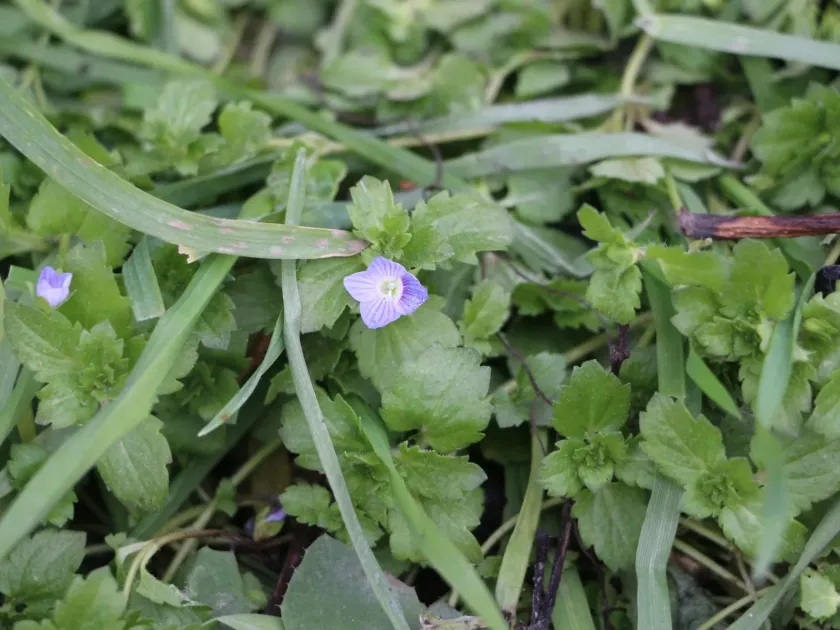
Persian speedwell (Veronica persica) is a low-growing annual weed belonging to the Plantaginaceae family. It is recognized as a prolific weed in both agricultural and horticultural settings.
The plant features sprawling, prostrate stems that can root at the nodes when in contact with damp soil. These stems are typically branched and covered in fine, spreading hairs.
The leaves are ovate to circular with coarsely toothed margins. They are arranged oppositely on the lower stem and alternately toward the flowering tips.
Flowers are singular, emerging from leaf axils on relatively long stalks. They have four petals, with a distinctive bright blue color, often marked with darker veins and a white center.
The fruit is a heart-shaped capsule containing numerous small, yellowish-brown seeds. These seeds are known for their ability to persist in the soil seed bank for several years.
Persian speedwell is widely distributed across temperate regions. It thrives in cultivated fields, gardens, and along roadsides, often appearing as a winter annual.
It prefers fertile, moist soil but is highly adaptable to various soil types. It is frequently found in winter wheat crops, vegetable beds, and perennial orchards.
The weed exhibits rapid development in early spring, often germinating after the first frost cycles. Its ability to grow in cool conditions gives it a competitive edge over many summer crops.
Agricultural fields that are frequently irrigated are particularly susceptible to heavy infestations, as consistent moisture promotes continuous germination cycles.
It can rapidly colonize bare soil patches, especially where crop canopy closure is delayed, making it a persistent nuisance in field management.
The primary impact of Persian speedwell is its role as a strong competitor for water, nitrogen, and other essential nutrients, leading to reduced crop vigor.
Because it creates a dense ground mat, it can shade out young crop seedlings, significantly inhibiting their growth during the critical early stages of development.
The weed acts as an alternative host for various pests and pathogens, including viruses and fungi that can eventually transfer to economically important crops.
Infestations reduce the overall yield and efficiency of agricultural operations. High densities of speedwell can complicate harvesting and increase the presence of impurities in the grain.
A sound cultural management strategy involves deep primary tillage to bury seeds at depths that inhibit successful germination and emergence.
Crop rotation remains one of the most effective non-chemical strategies, as it interrupts the life cycle of the speedwell by altering environmental and management factors.
Mechanical control, such as pre-emergent harrowing or timely inter-row cultivation, is effective if performed while the weeds are still in the cotyledon or early leaf stage.
Chemical control utilizing selective herbicides is a standard practice in commercial agriculture. Applications should be timed carefully, targeting the weed in its most susceptible early growth phase.
Integrated weed management (IWM) that combines competitive crop varieties, proper seeding density, and judicious herbicide use provides the best results for keeping populations below economic damage thresholds.


